Origen — Coal, Territory and the Energy Transition in Spain
Origen
A tribute to a fading
era
Coal, territory and the energy transition in Spain
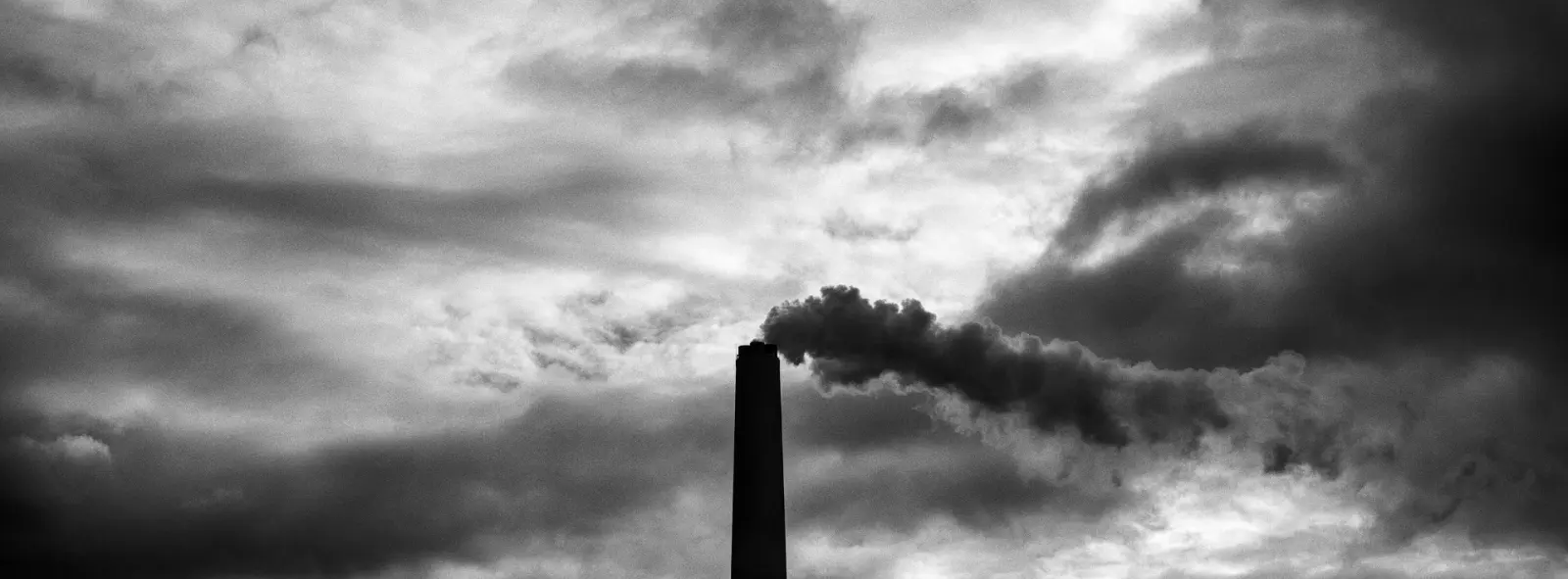
Spain, 2021.
The silhouette of a power-plant chimney is cut against a heavy sky. For half a century these structures shaped the landscape and the employment of entire regions; today they mark the starting point of Spain's decarbonization.
No one is ever ready for a farewell. Not even those who have spent half a lifetime knowing that, sooner or later, it would come. For years, the end of coal in Spain was a distant certainty, an idea repeated without ever quite arriving, as though there were always a little more time left. But the transition eventually prevailed, and when it did, it transformed the landscape and the rhythm of many territories in the span of just a few years. The chimneys stopped emitting, the turbines fell still, and the power plants — those structures that for decades had organized the life of entire regions — fell silent. There was no single image that summed up the change, but rather a succession of scenes that, little by little, built the sense of an era coming to a close.
What was being switched off was not merely a way of producing energy. It was a way of understanding the land, work and progress.
For much of the twentieth century, coal was the axis on which an essential part of Spain's industrial development rested. It not only generated electricity; it shaped the lives of those who lived in the mining basins and around the thermal power plants. In the north and in the interior of the peninsula, entire towns grew up around pits, conveyor belts and cooling towers. Time was measured in shifts, in relays, in production cycles. There was hardship, there was risk, but also a clear sense of stability. To be part of that system meant belonging to something greater, to a machinery that sustained the workings of a country advancing toward modernity.
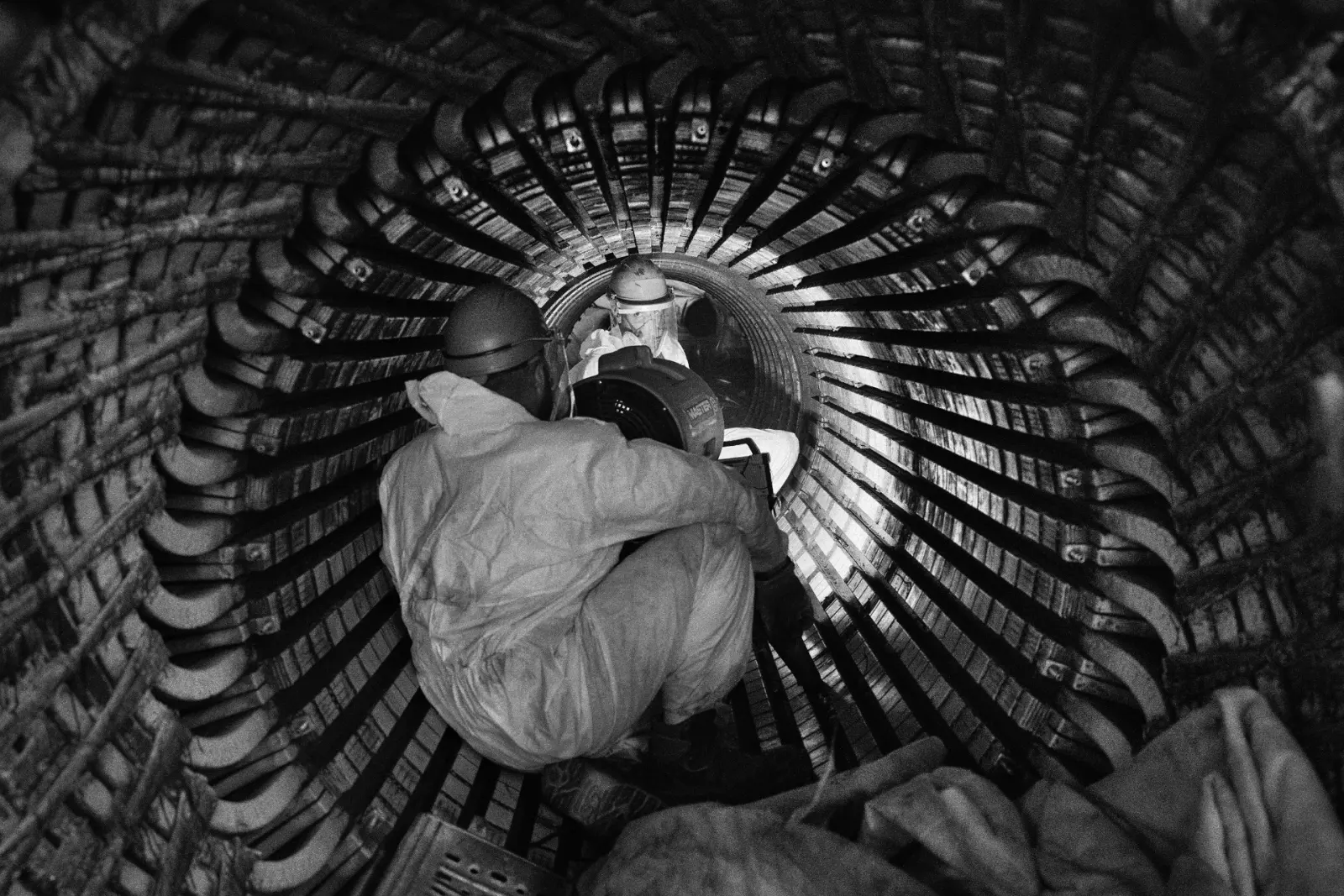
Litoral Thermal Power Station, Almería (Spain) – 10 October 2023.
Workers labor inside one of the turbines of the Litoral Thermal Power Station.
That model endured for decades. It weathered political upheavals, economic crises and social change. Plants such as As Pontes, Compostilla II, Andorra and Litoral were key pieces of that system, infrastructures that operated in a discreet background while ensuring that energy reached millions of homes. But time began to shift. Environmental requirements grew stricter, the costs tied to emissions rose, and technology opened up new possibilities. The balance that had sustained coal for so long began to give way.
It was not an abrupt rupture but a cumulative process. Adaptations, reforms, attempts to extend the working life of the plants. In some cases the plants were modernized to reduce their environmental impact. In others, the context simply ceased to be compatible with their continuity. By the late 2010s, the transition accelerated decisively. European regulations, the cost of carbon and the need to move toward a more sustainable energy model drove the closure of the thermal power plants. In a relatively short span, Spain left behind a technology that had been central for more than half a century.
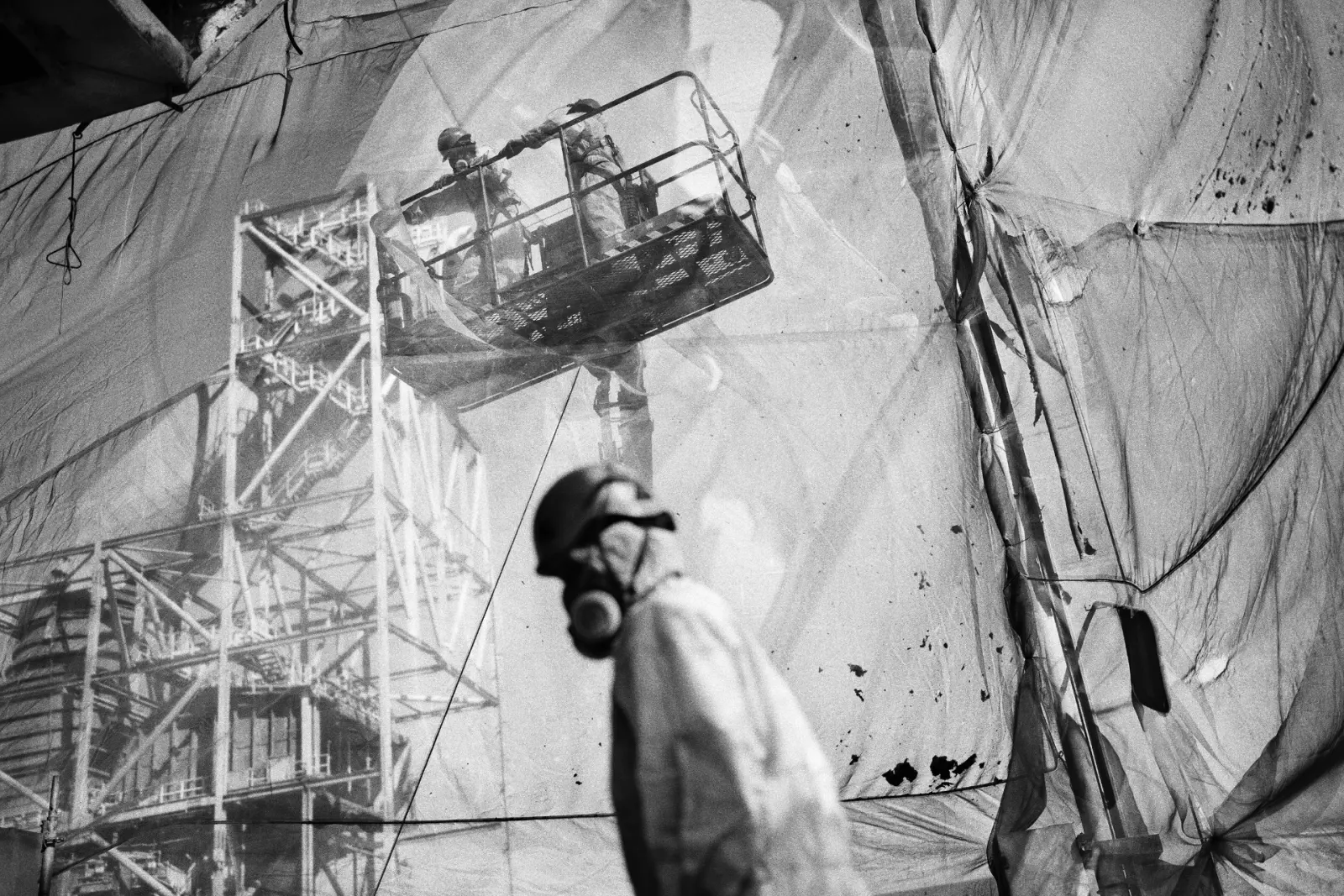
Litoral Thermal Power Station, Almería (Spain) – 10 October 2023.
A crew works inside a safety enclosure at the Litoral Thermal Power Station. Each zone is sealed off before work begins: dust, asbestos, and height dictate every movement of the crew.
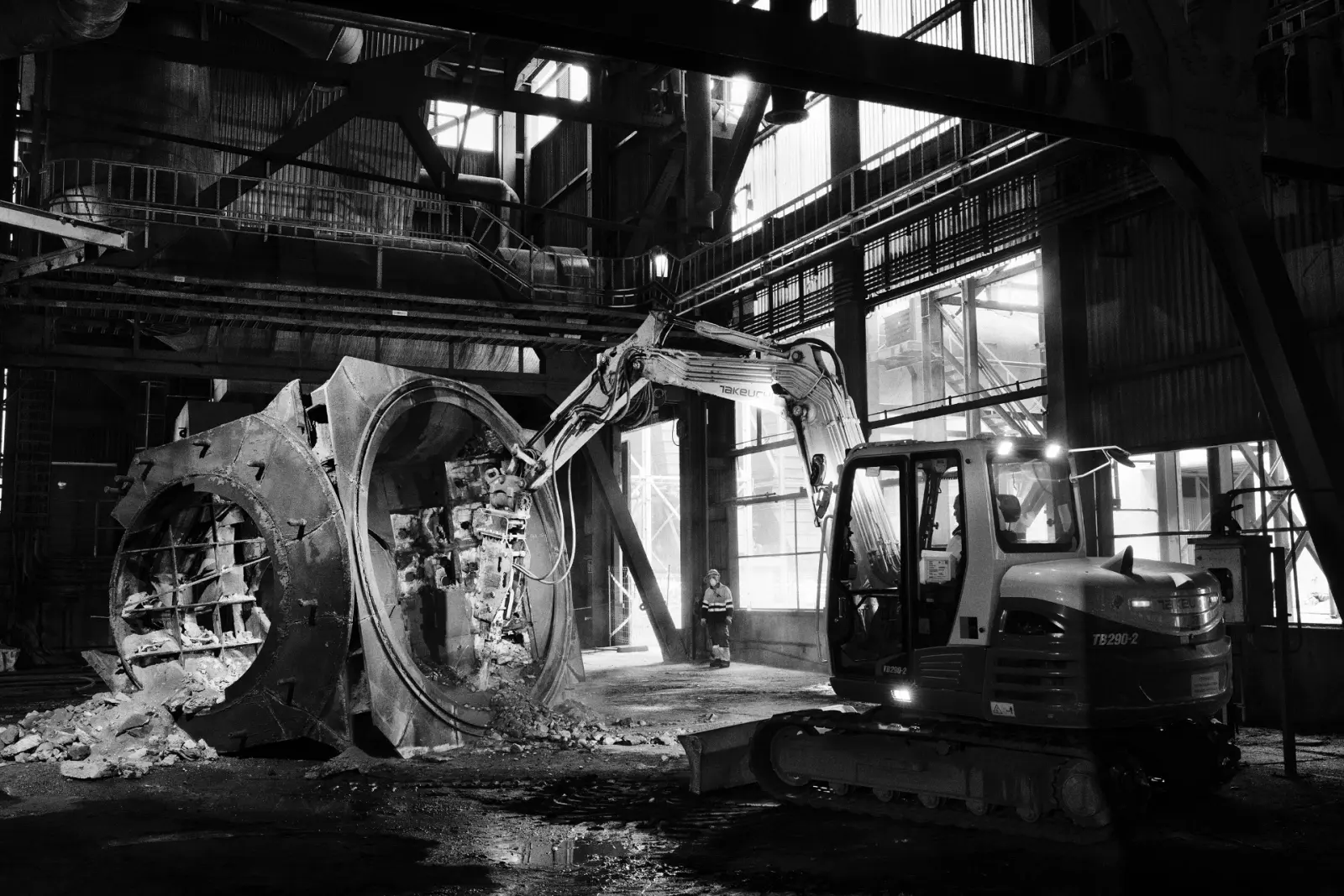
As Pontes, Galicia (Spain) – 9 October 2025.
Heavy machinery clears the way inside the As Pontes Thermal Power Station. What was once the turbine hall becomes a construction site: removing coal from the memory of a valley first requires emptying it of iron.
From a global perspective, the change was evident. Emissions fell significantly and the electricity system began to transform. But on the ground, the transition had another dimension. In the territories where coal had been the axis, what was opening up was not simply a different future, but a time that demanded adaptation. The plants were not merely industrial facilities; they were employment, identity, a sense of belonging. Their dismantling forced a rethinking of the place these communities would occupy in a new context.
And yet, that very process began to reveal another possibility.
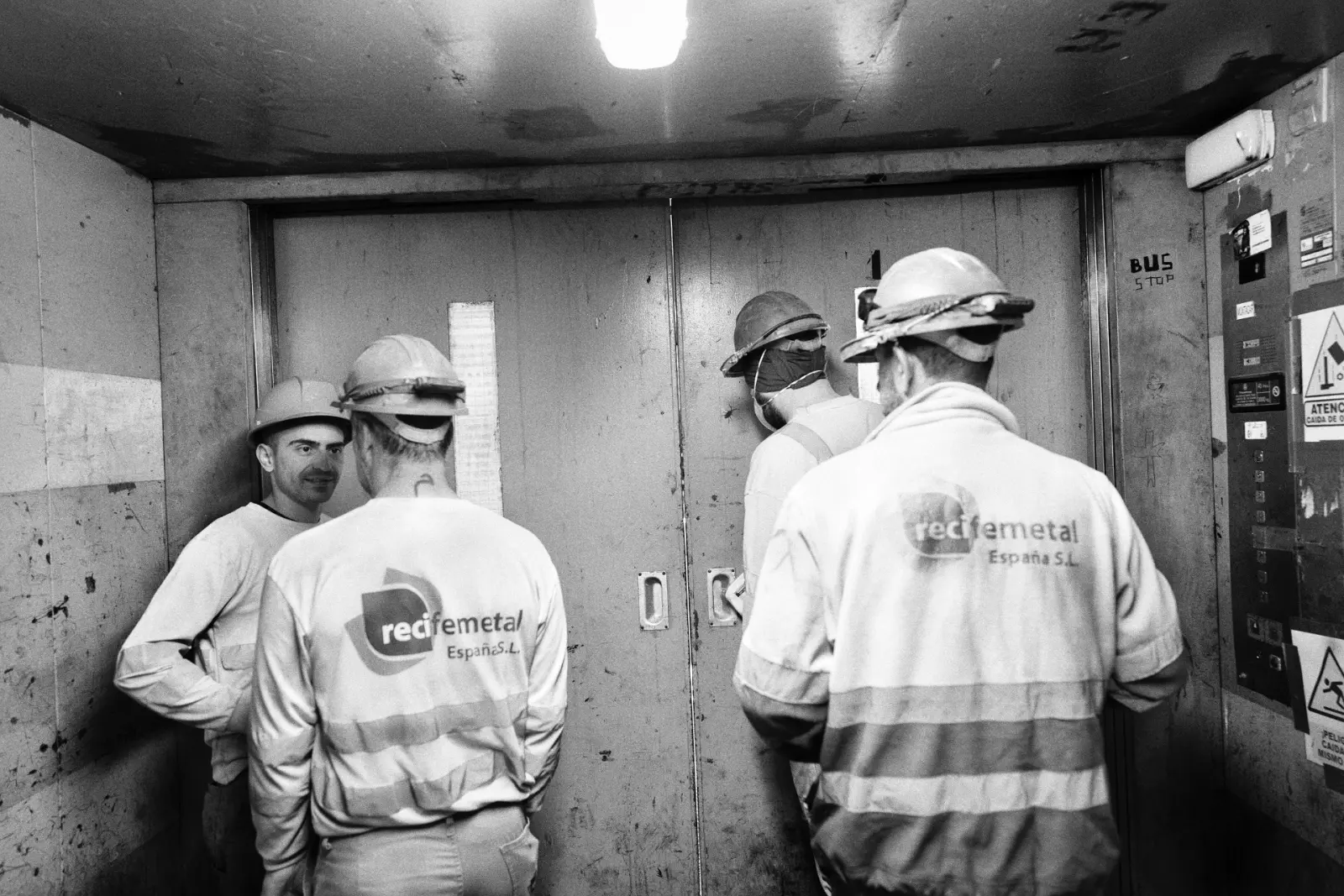
As Pontes, Galicia (Spain) – 9 October 2025.
Cleaning and sorting of rubble in As Pontes. More than ninety percent of the material that leaves a thermal power plant is recovered: steel, copper, concrete, and insulation follow separate recycling routes.
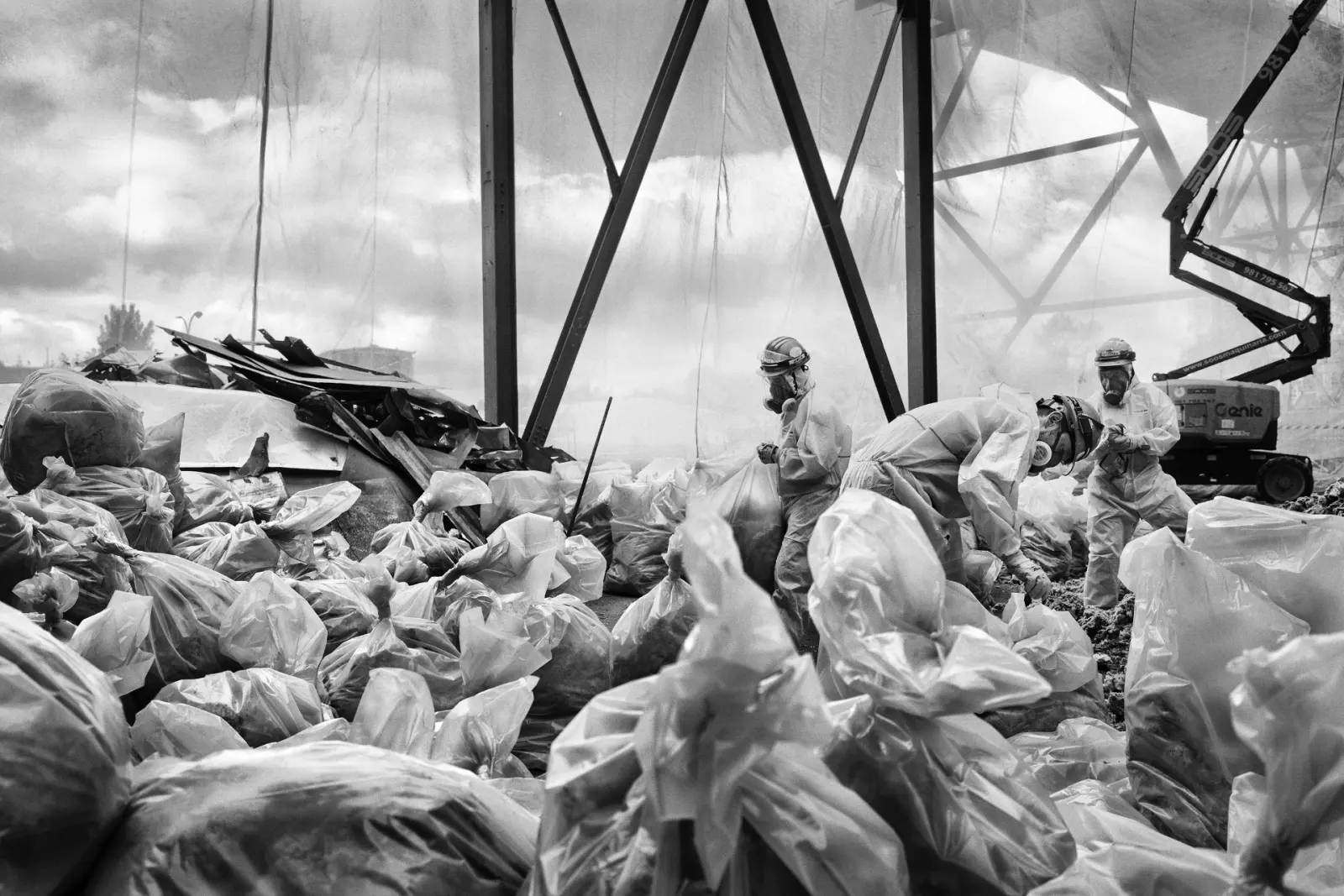
Compostilla Thermal Power Station, Castilla y León (Spain) – 2 July 2024.
Workers ride the elevator up to their posts at the Compostilla Thermal Power Station. The same trades that sustained the coal era in El Bierzo are now the ones dismantling it.
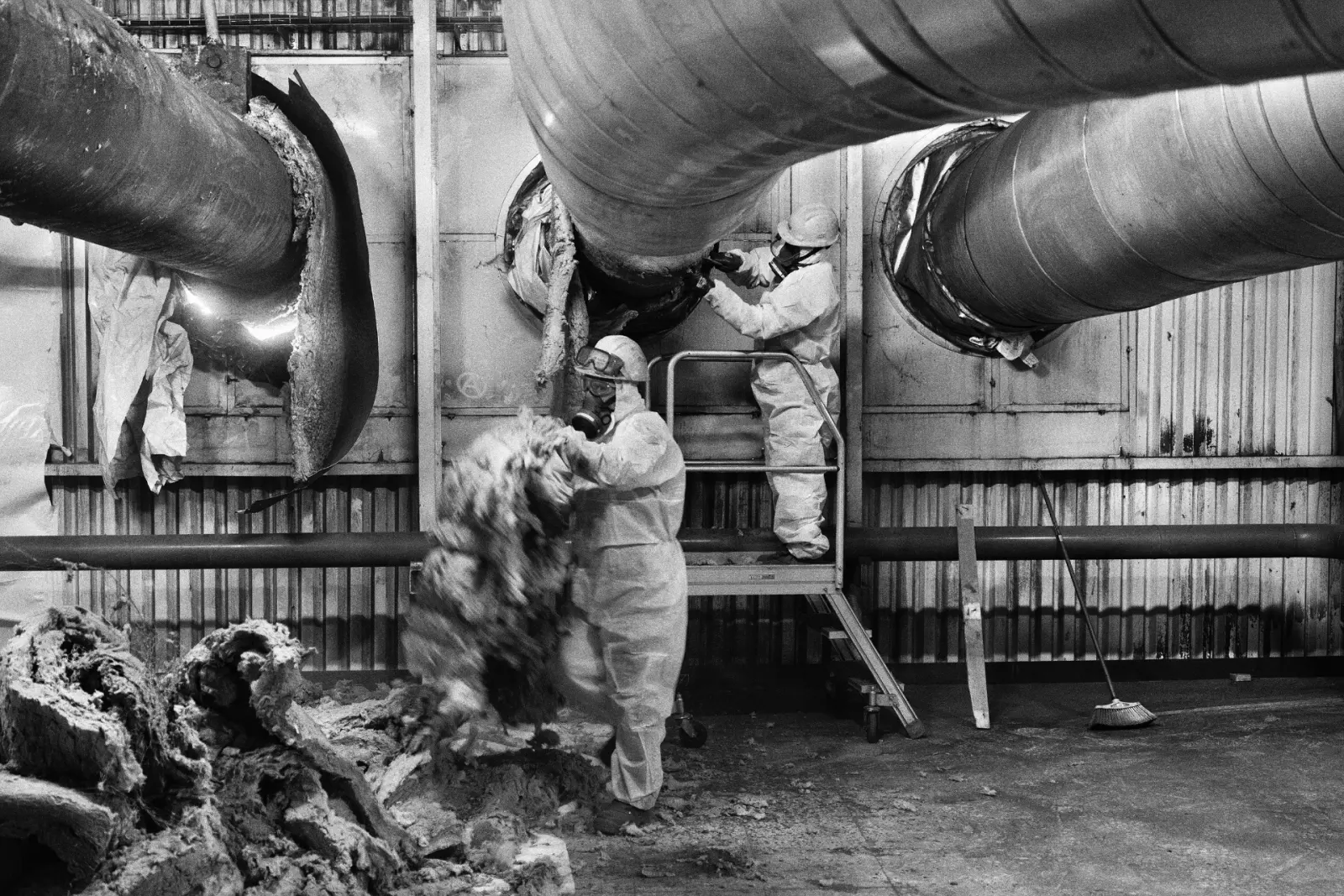
Andorra Thermal Power Station, Teruel (Spain) – 17 March 2023.
A confined interior of the Andorra Thermal Power Station during dismantling work. A few kilometers away, on the same company land, the region's first photovoltaic plants are already rising.
While coal was being switched off, a new way of producing energy was beginning to unfold with force. Spain, with its abundance of sun and wind, found in renewables a natural path forward. Wind turbines began to appear along ridgelines and plateaus, solar plants came to occupy vast stretches of land in the south and the interior, and territories that had once played no strategic role in the energy system began to take center stage. Within a few years, wind and solar power moved from occupying a marginal space to becoming the core of electricity generation. Today, more than half of the country's electricity comes from renewable sources.
That transition has not been merely technological. It has also been territorial and human.
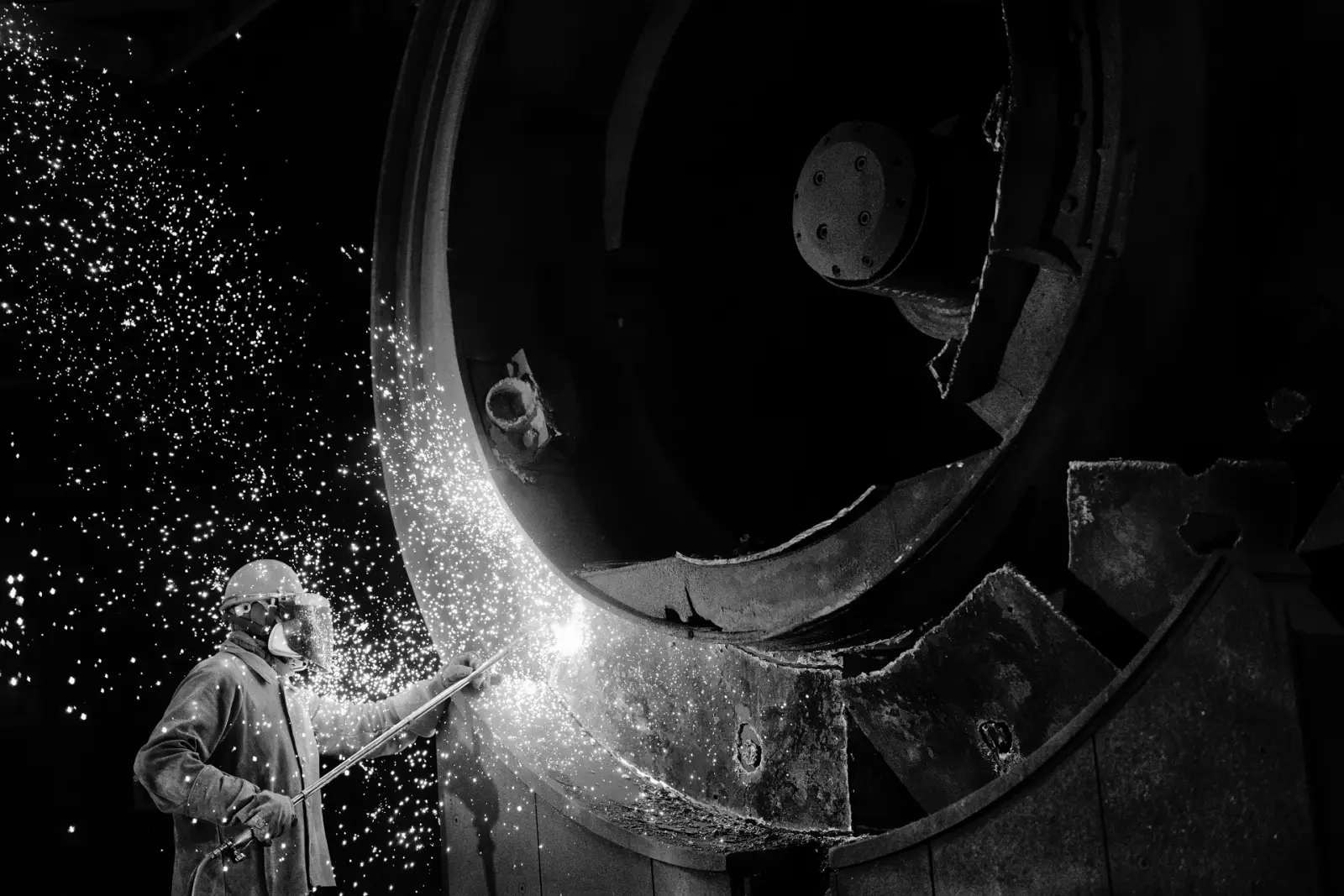
As Pontes, Galicia (Spain) – 9 October 2025.
Torch-cutting in As Pontes. Dismantling is measured in cuts: thousands of pieces separated by hand before the structure can be brought down safely.
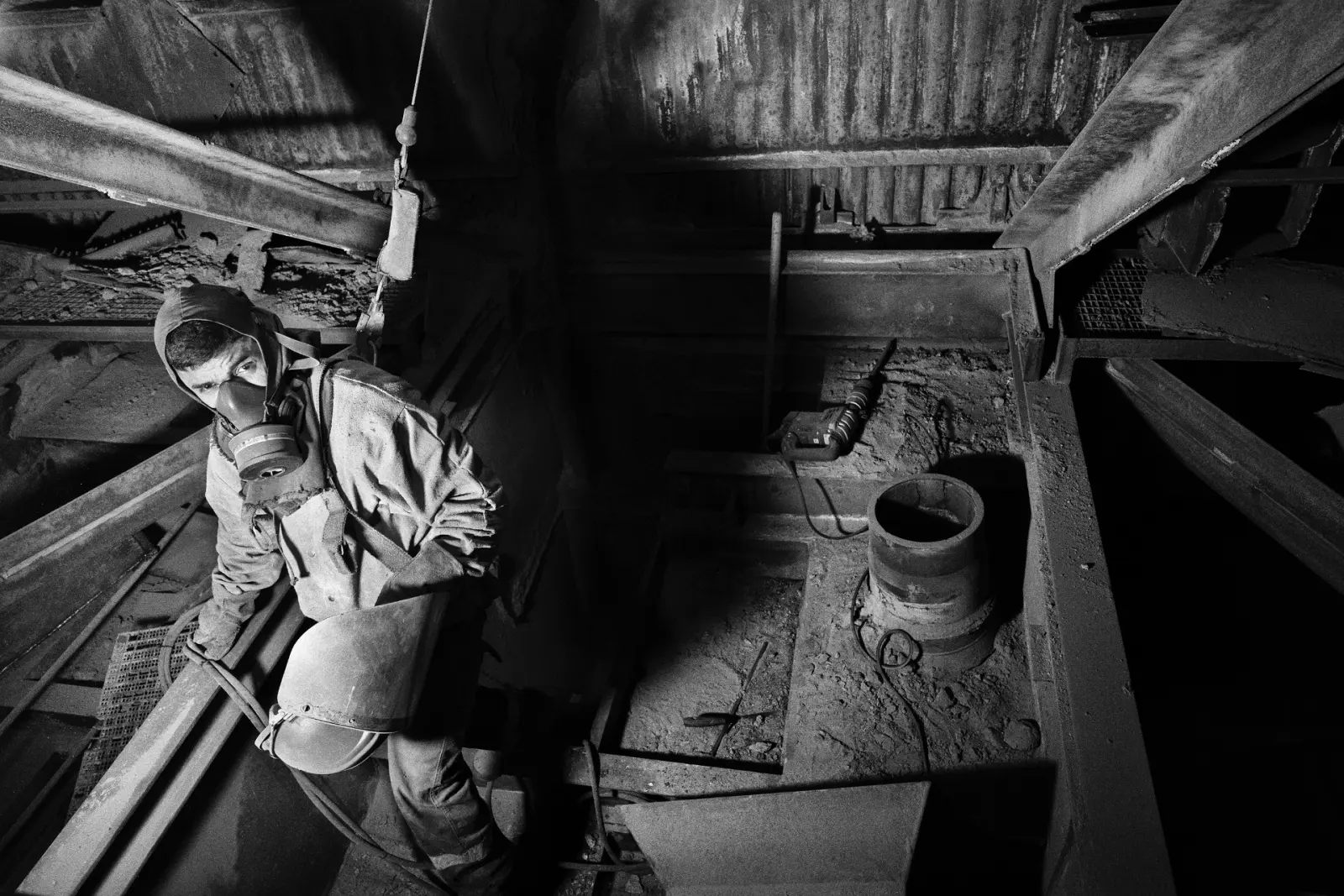
Compostilla Thermal Power Station, Castilla y León (Spain) – 2 July 2024.
A worker cuts the anchors of one of Compostilla's boilers, in an already advanced stage of dismantling. Freeing the boiler from its supports is the step before its controlled fall.
In some places, the transition can be read through personal trajectories spanning generations. Families who have lived through the passage from mining to power generation and, now, to renewable energy. The journey has not always been easy, but it has opened an unexpected continuity. Where work once concentrated at a single point — the plant, the mine — it is now distributed across a network of installations that occupy the land in a different way. Energy ceases to be concentrated and instead unfolds outward. The scale changes, the logic changes, and so does the relationship with the surrounding environment.
This new renewable energy has something different about it. It draws directly on natural resources. Wind, sun, water. Elements that have always been there and that now acquire strategic value. In territories that for years had watched their population dwindle or their activity decline, new opportunities begin to emerge. Not as an immediate replacement for what came before, but as an opening toward the future. New forms of employment, new industrial projects, new possibilities for putting down roots.
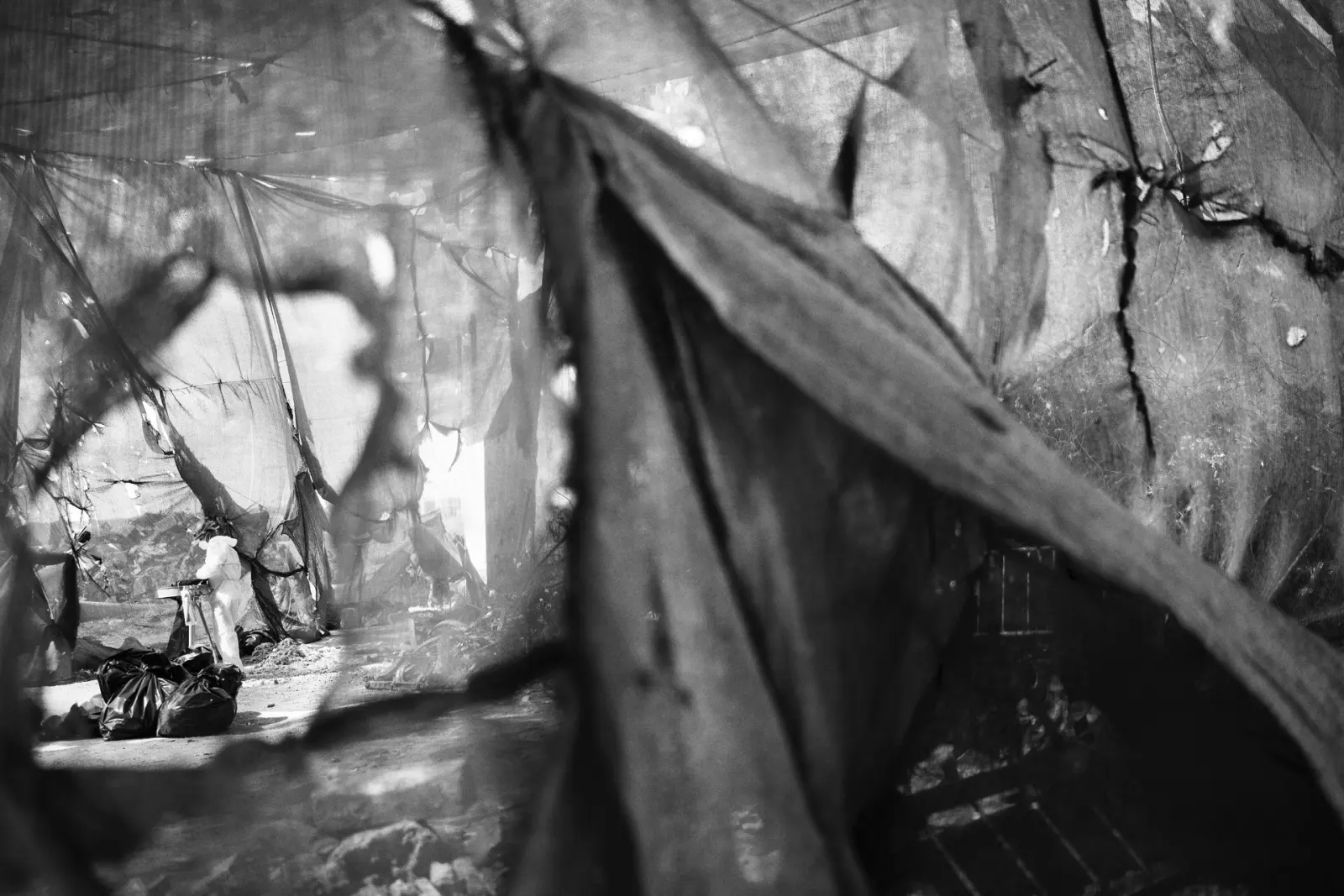
Compostilla Thermal Power Station, Castilla y León (Spain) – 1 July 2024.
Cleaning and recycling tasks in a safety enclosure at Compostilla. Much of the work is not demolition but separation, labeling, and removal: a patient inventory of the industry that is leaving.
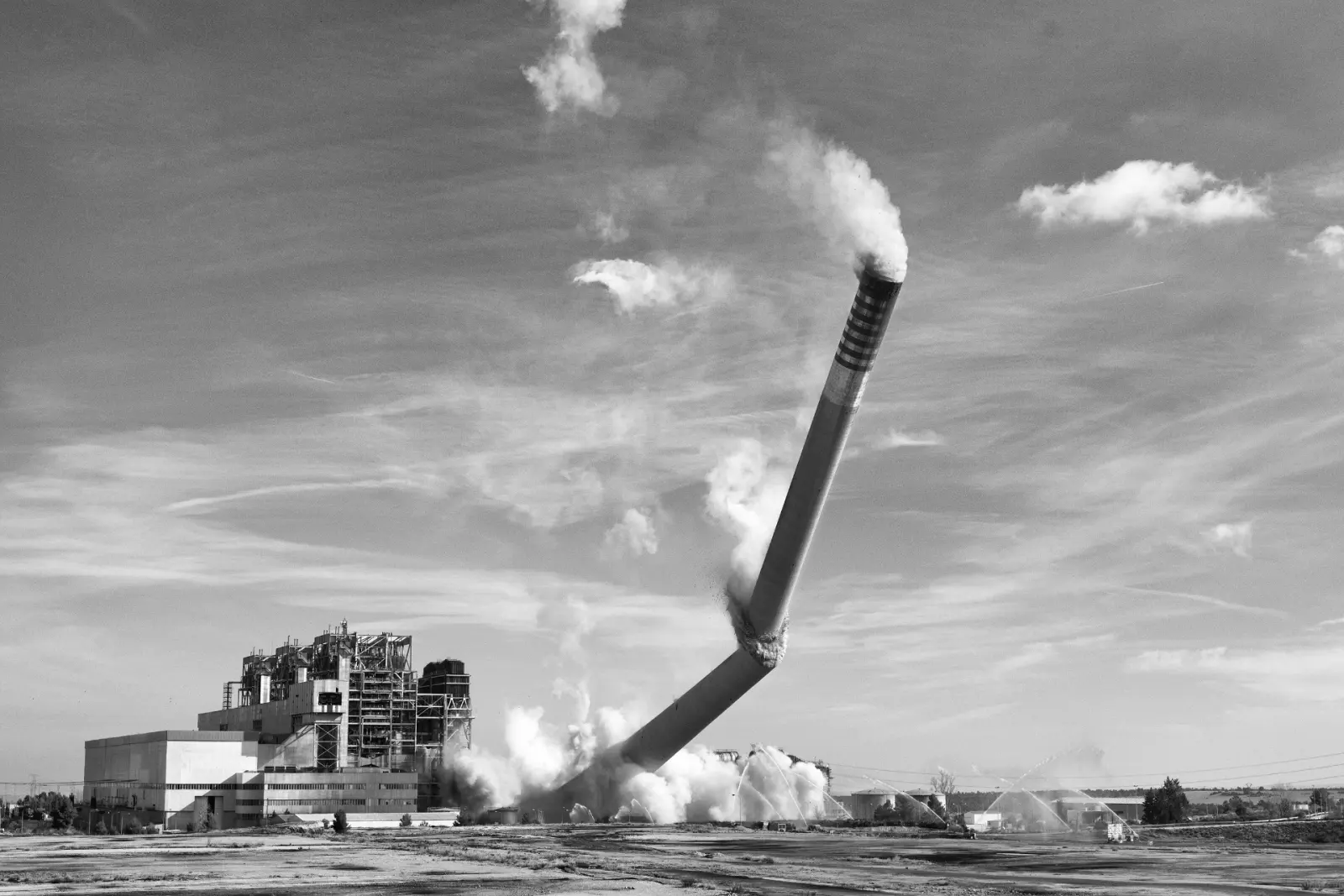
Andorra Thermal Power Station, Teruel (Spain) – 16 February 2023.
First part of the sequence of the blasting of the Andorra chimney, 343 meters that for decades were the visible landmark from across the whole Teruel region.
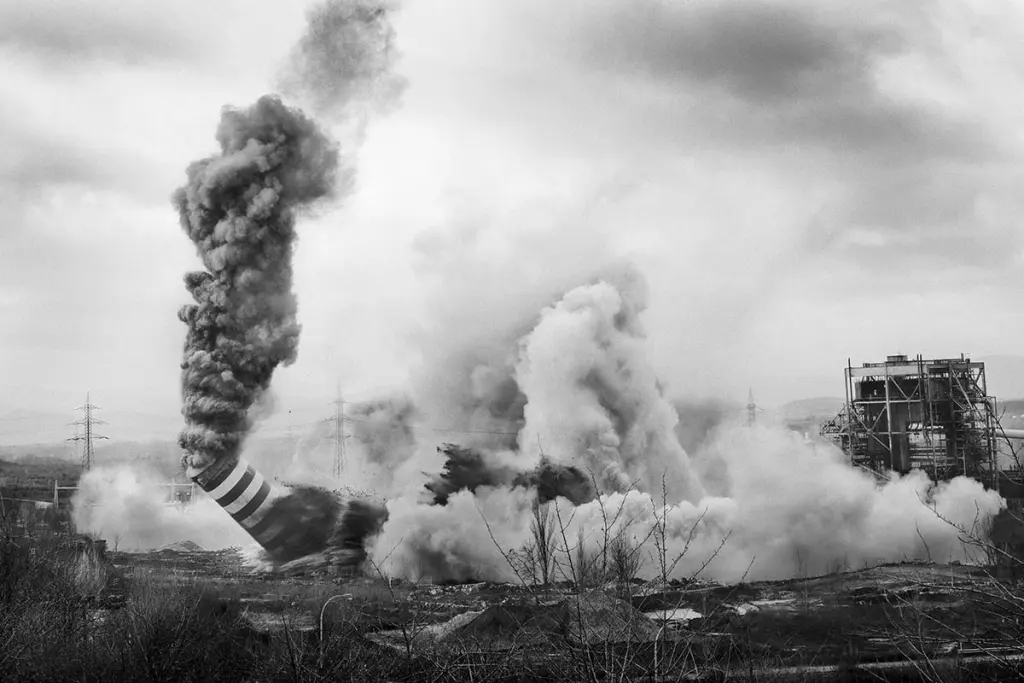
Compostilla Thermal Power Station, Castilla y León (Spain) – 12 February 2026.
The head of the Compostilla chimney, moments before touching the ground after its blasting.
The rollout of renewables has been neither linear nor free of complexity. It has required dialogue, adaptation, time. In some places, the arrival of wind farms or solar plants initially generated resistance or uncertainty. But it has also made it possible to explore ways of integrating with the land, of local participation, of shared value creation. Municipalities have found in these projects a means to strengthen their economies, improve infrastructure, and revive traditional activities.
The transition, in that sense, is not simply a change of technology. It is a process of collective learning.
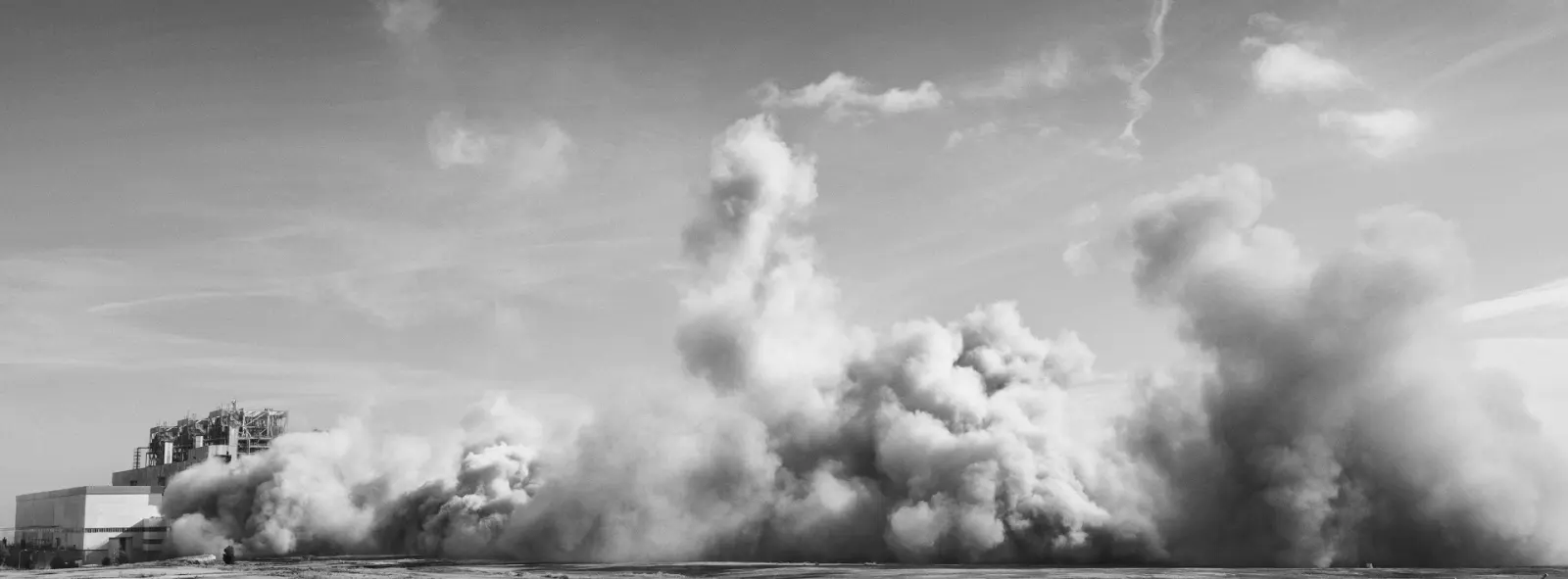
Andorra Thermal Power Station, Teruel (Spain) – 16 February 2023.
Second part of the sequence: the Andorra chimney folds in on itself within seconds. Local residents watched the blast from the surrounding area, as if attending a collective funeral.
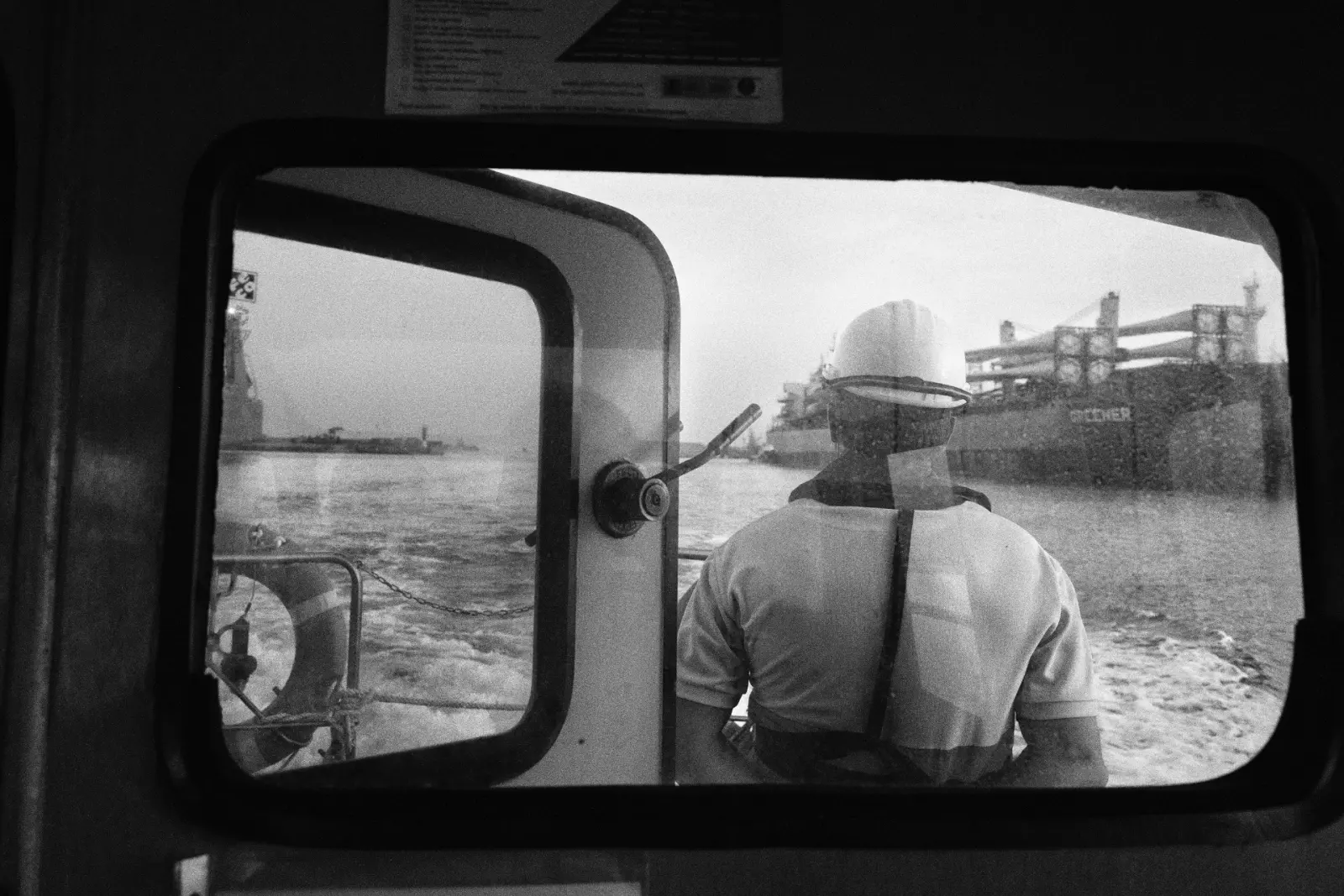
Port of Castellón, Valencian Community (Spain) – 7 November 2021.
A dockworker oversees the approach of a ship loaded with components for a wind farm under construction. The new energy arrives by sea before climbing to the mountains.
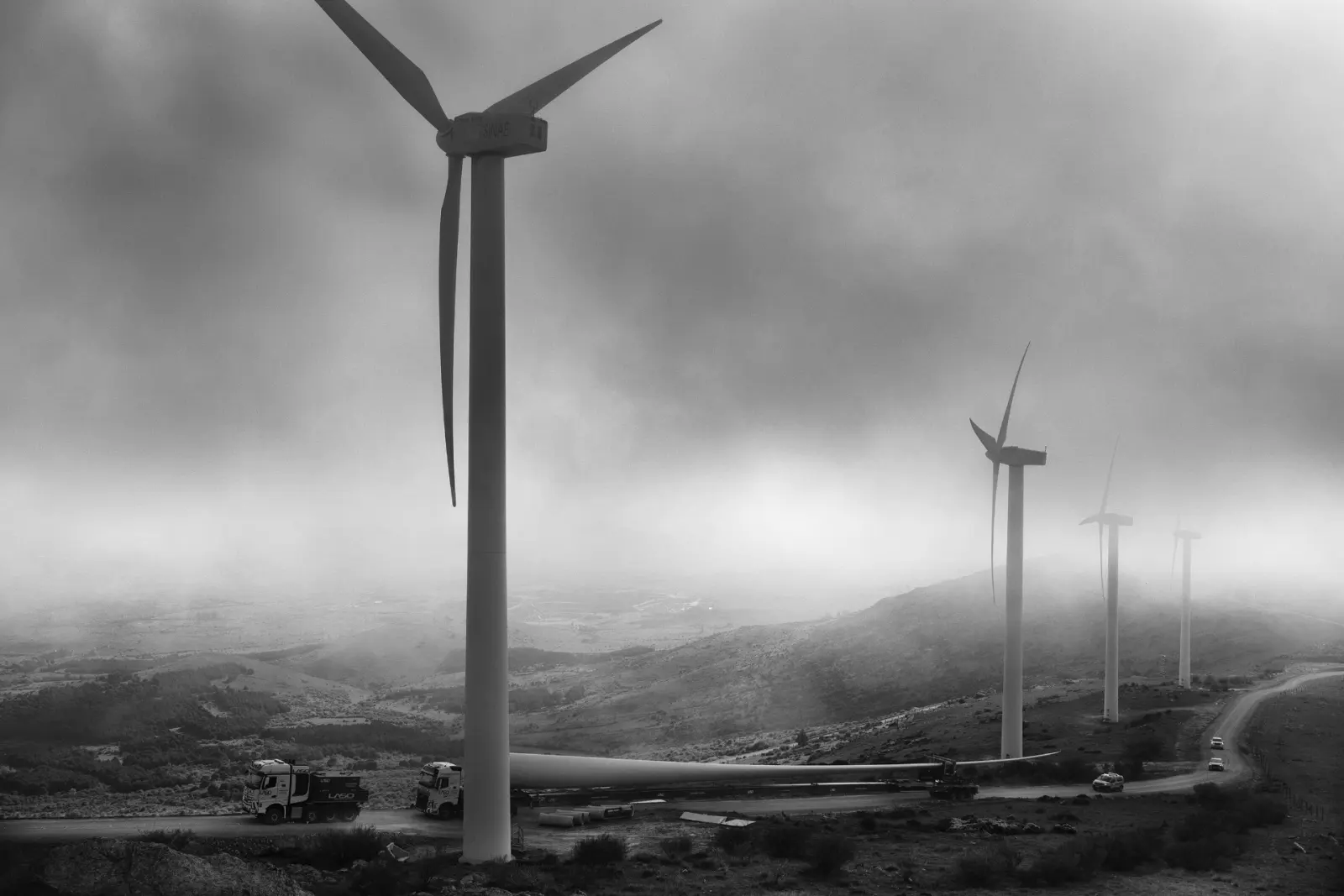
Aldeavieja, Ávila (Spain) – 22 May 2025.
A special convoy carries a wind-turbine blade up the roads of the Sierra de Ojos de Albos. Each piece travels by night, under escort, along curves measured to the centimeter.
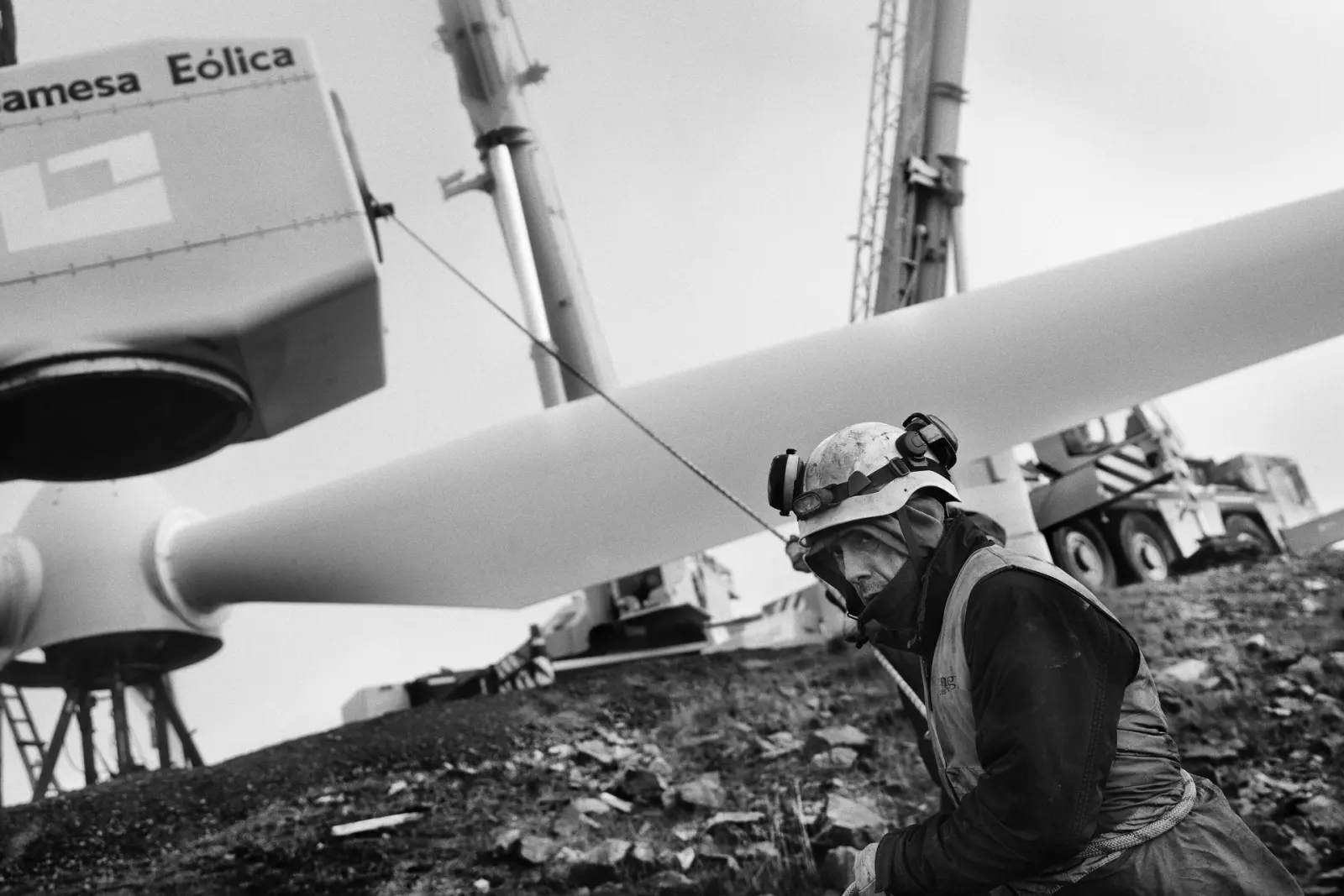
Aldeavieja, Ávila (Spain) – 16 October 2024.
A worker guides the rotor of a wind turbine with a rope during hoisting. Tons of suspended steel positioned with the precision of a hand gesture.
At the same time, the closure of the plants has been accompanied by rigorous technical work that has given shape to the end of this stage. Dismantling a thermal power plant is neither an immediate nor a symbolic act. It is a complex process that unfolds over years, requiring planning, safety and specialized knowledge. Every structure is taken down with precision, every material is managed, every space is prepared for its next use. It is not about erasing, but about transforming the land for the future.
These dismantling processes have also generated economic activity and employment. Specialized teams, specific training, opportunities for those who were once part of coal's value chain. The knowledge accumulated over decades does not disappear; it adapts and finds new applications in a different context. The sites themselves also retain considerable strategic value: grid access, logistics infrastructure, development capacity. Places that for years were centers of energy production may become so again, now under the logic of renewables.
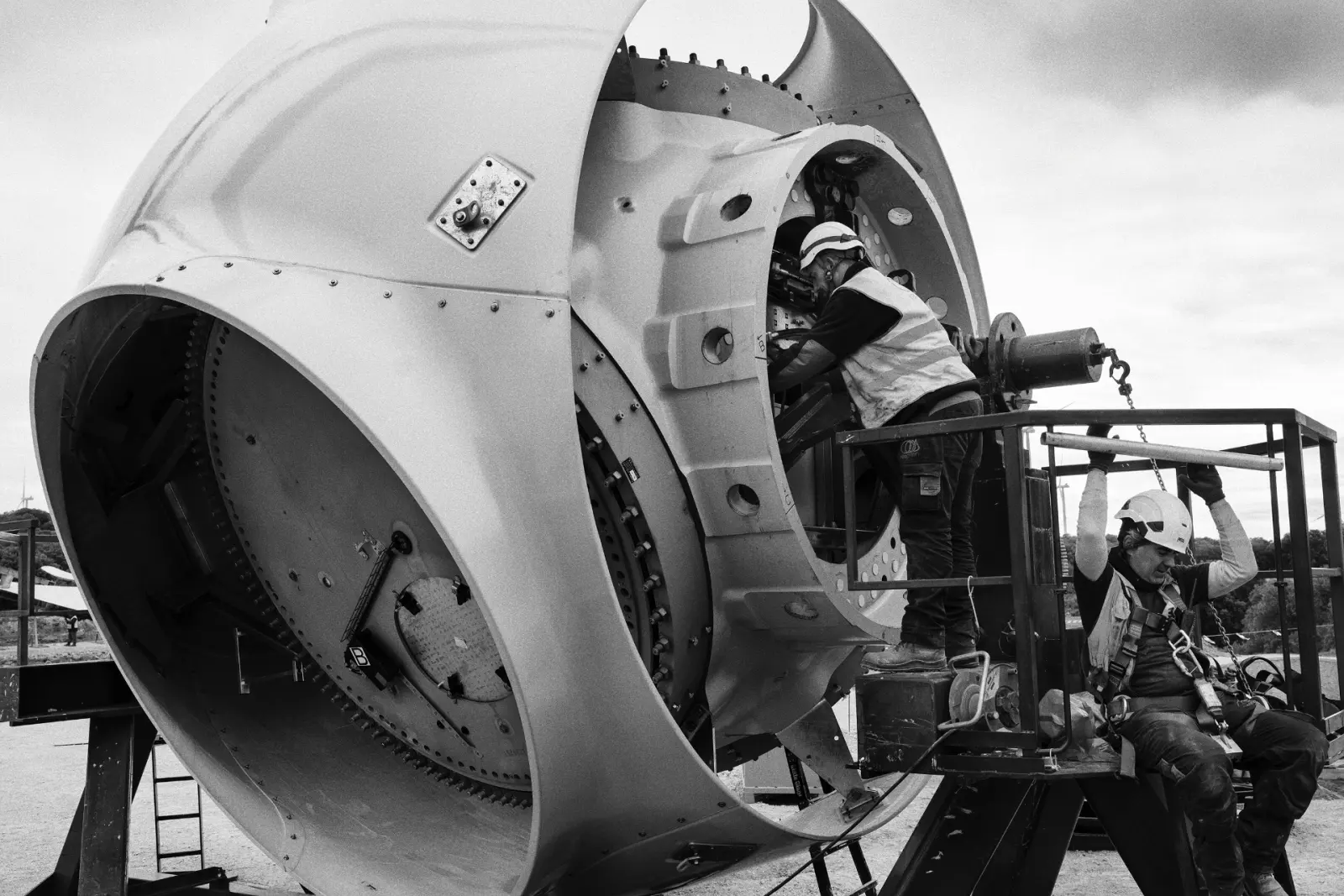
Muniesa Wind Farm, Teruel (Spain) – 9 January 2024.
Workers labor inside the rotor of a wind turbine at the Muniesa Wind Farm. The machine's interior is a narrow workshop dozens of meters above the ground.
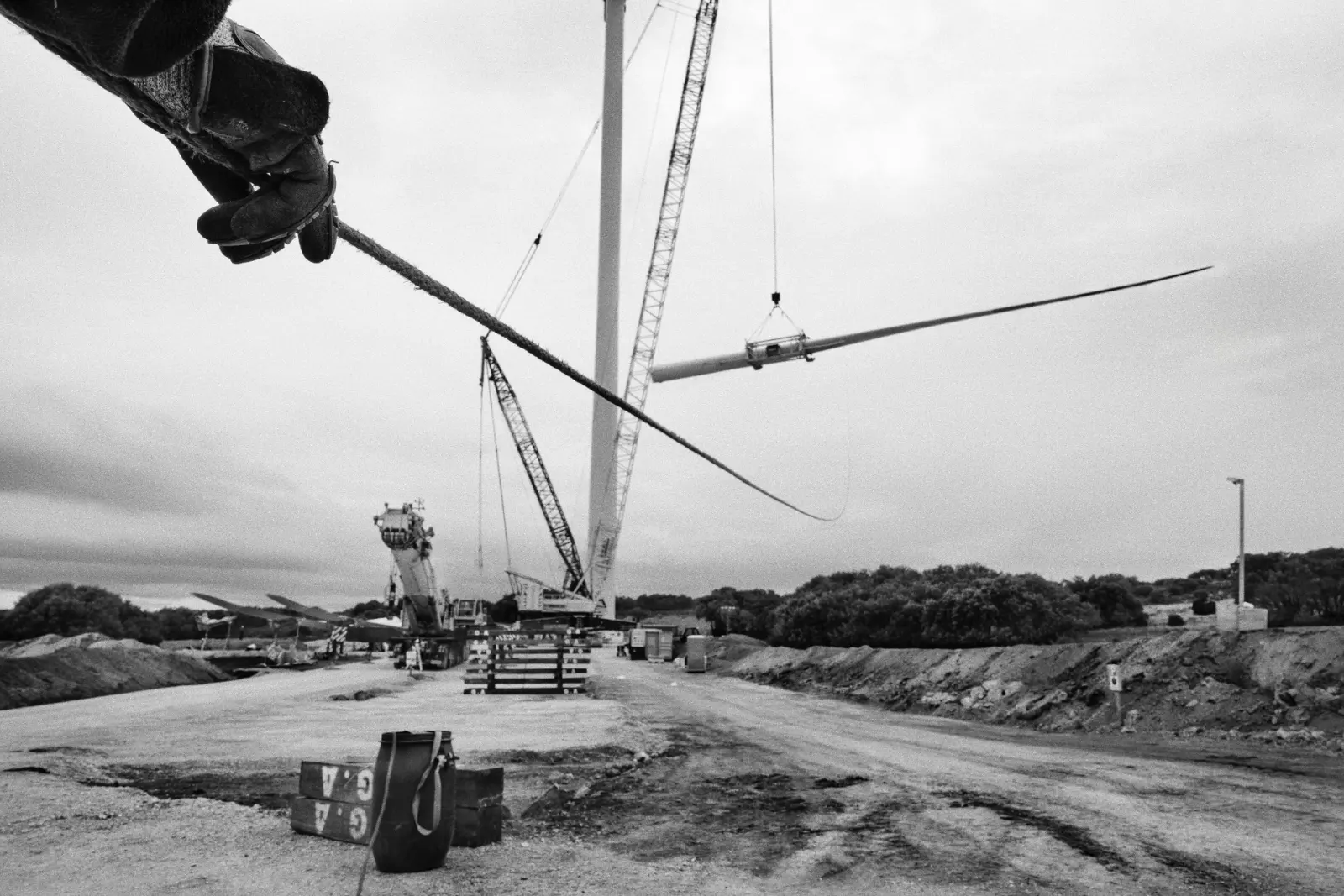
Muniesa Wind Farm, Teruel (Spain) – 10 January 2024.
Blade assembly in Muniesa. The wind, the farm's raw material, is also the enemy of the maneuver: beyond a certain speed, the crane must stop.
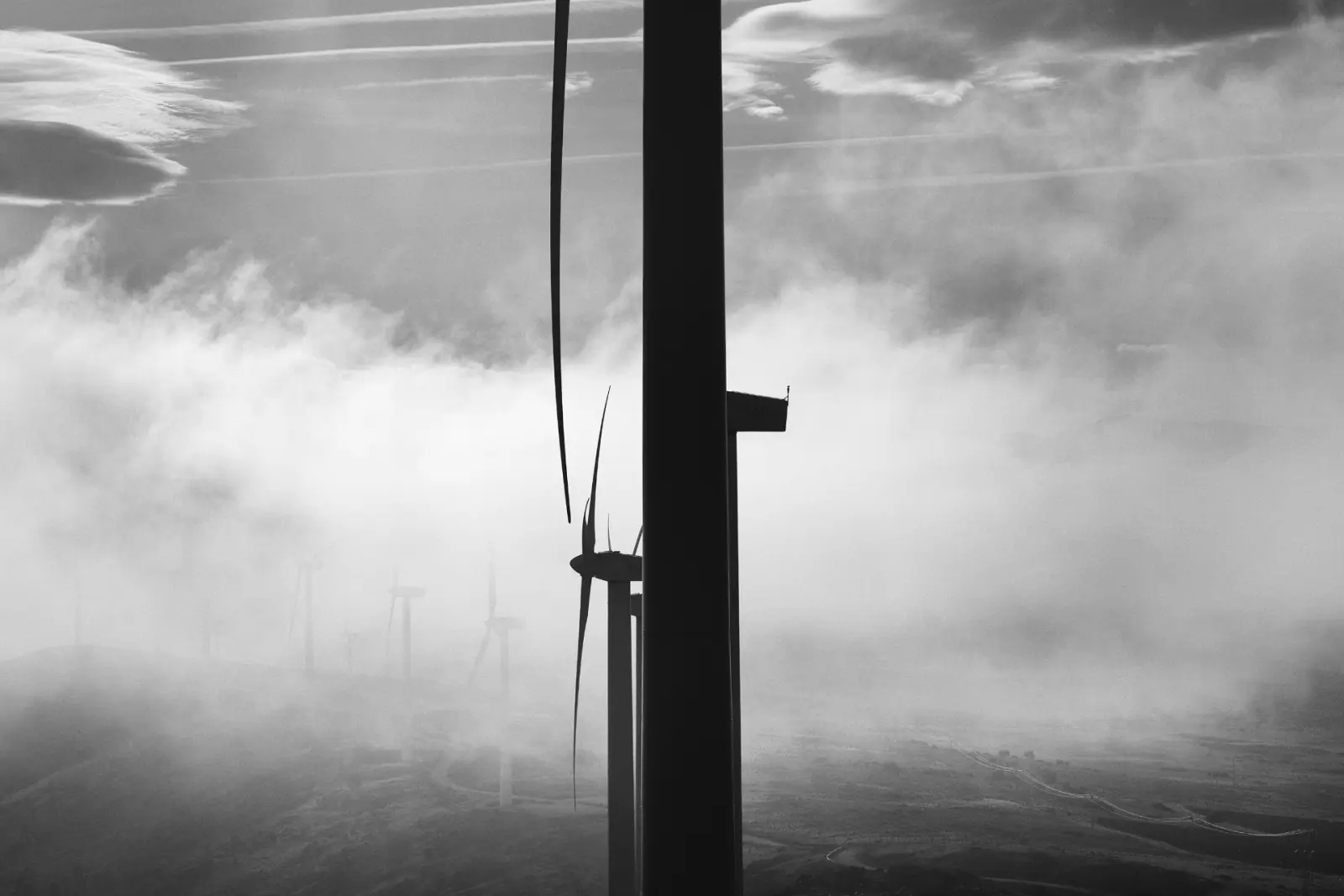
Aldeavieja, Ávila (Spain) – 22 May 2025.
The wind turbines of the Aldeavieja Wind Farm follow the line of the Sierra de Ojos de Albos. A new silhouette settles on the horizon where once there was only hillside.
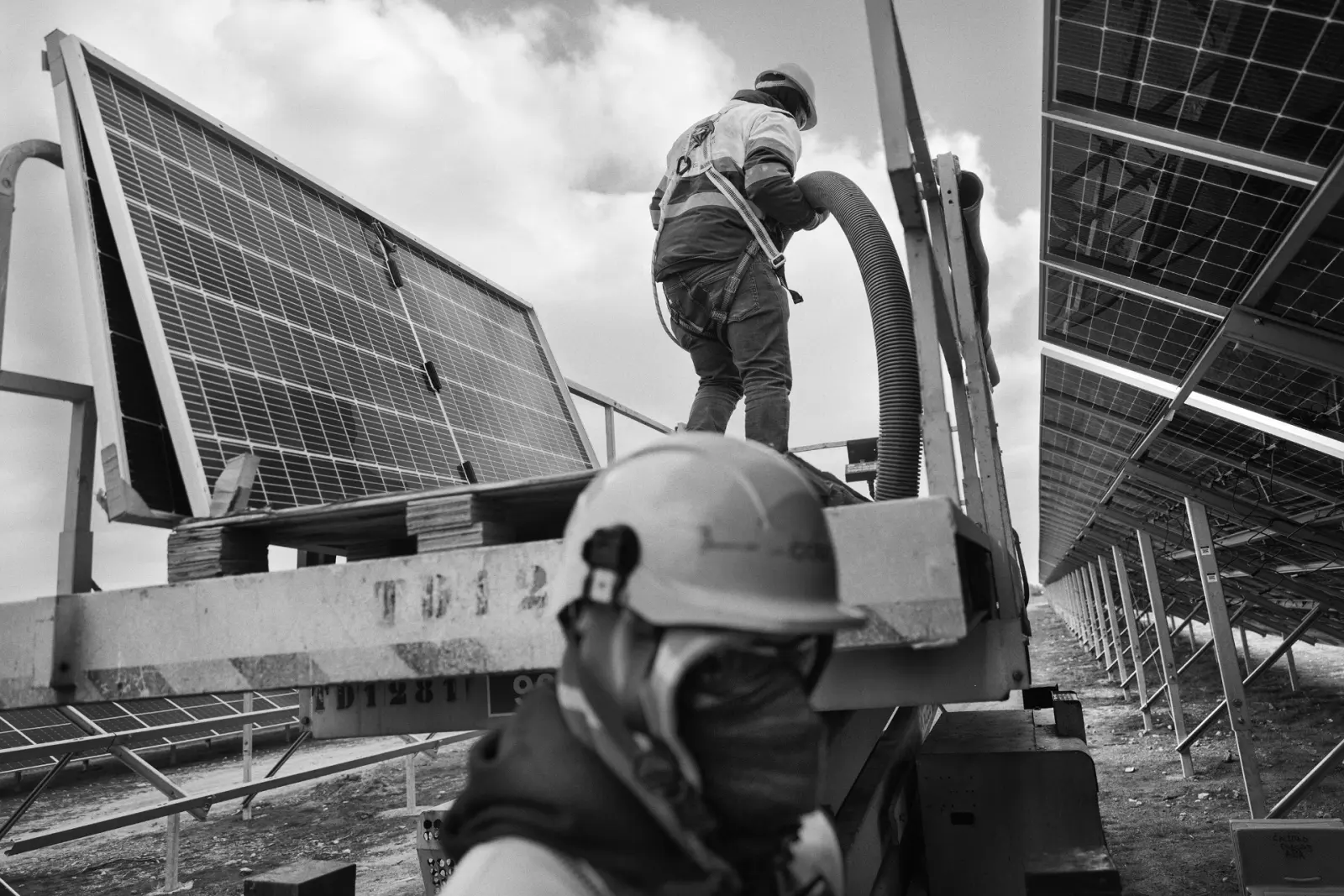
Andorra, Teruel (Spain) – 2 March 2023.
Installation of photovoltaic panels on the grounds of the former Andorra thermal power plant. The same ground that burned coal for forty years begins to produce solar electricity.
The landscape today reflects that transition in progress. In some places, structures in the process of being dismantled coexist alongside new renewable installations. It is possible to see, on the same horizon, the mark of what once was and the shape of what is arriving. Not as a contradiction, but as an overlapping of eras.
As the electricity system incorporates more and more renewable energy, the need to strengthen other elements also becomes clear. The transmission and distribution grid, management capacity, system stability. Energy is no longer only a matter of how it is produced, but of how it is integrated and distributed across the territory. Recent episodes have highlighted the importance of that invisible infrastructure, that web of lines and systems that allows everything to keep running smoothly.
The energy transition is, therefore, a broad process. It is not limited to closing down some technologies and opening up others. It calls for rethinking the system as a whole, from generation to consumption, through the grid, management and storage. It is a transformation that affects the way a country organizes itself, produces, and inhabits its territory.
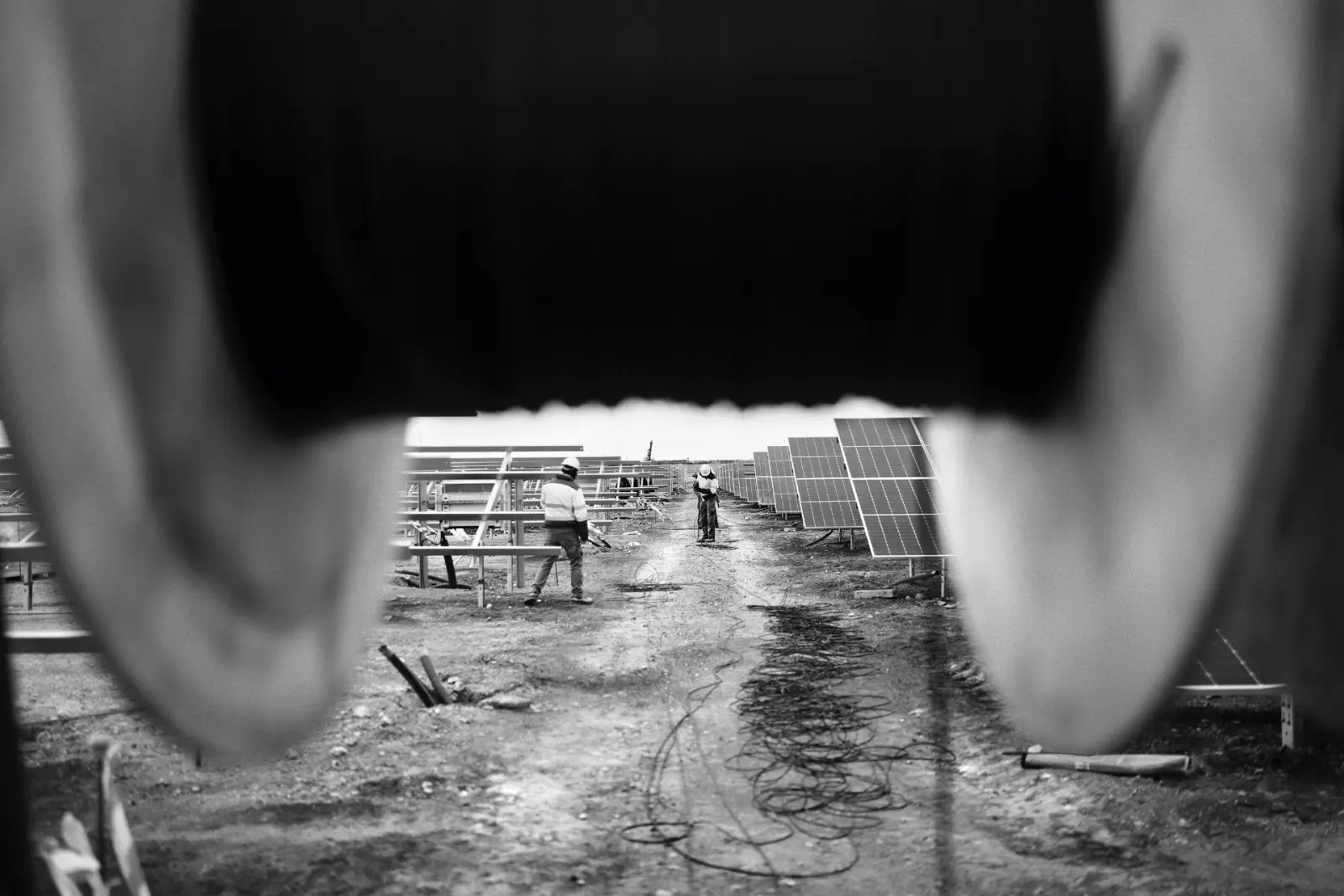
Andorra, Teruel (Spain) – 28 January 2025.
Two years later, the Andorra solar field keeps growing row by row. Many of those bolting down the modules once worked at the plant or the mine.
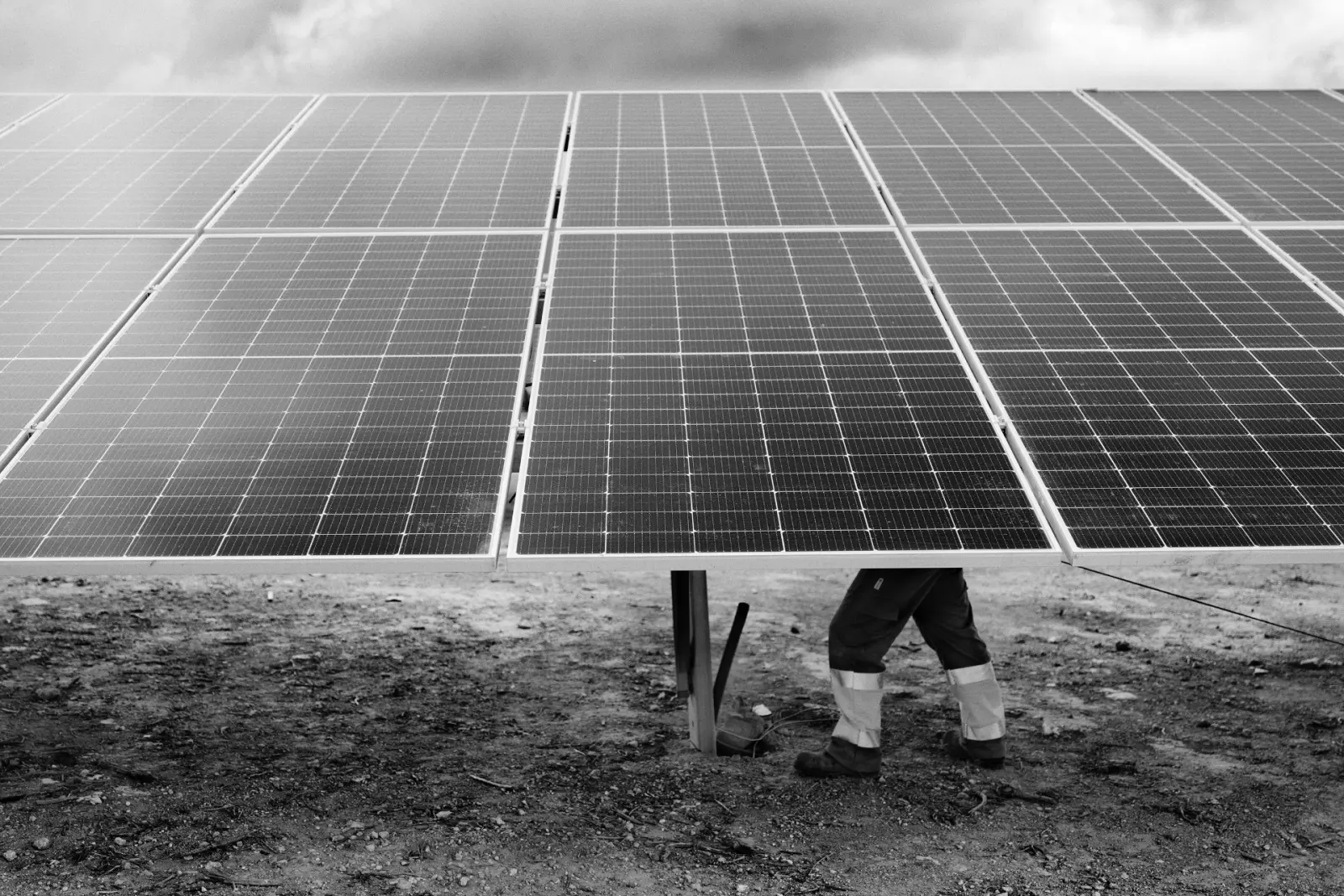
Andorra, Teruel (Spain) – 18 April 2023.
A technician works behind the rows of modules, on the site of the former thermal plant. Cables replace the coal conveyor belts; maintenance replaces the control room.
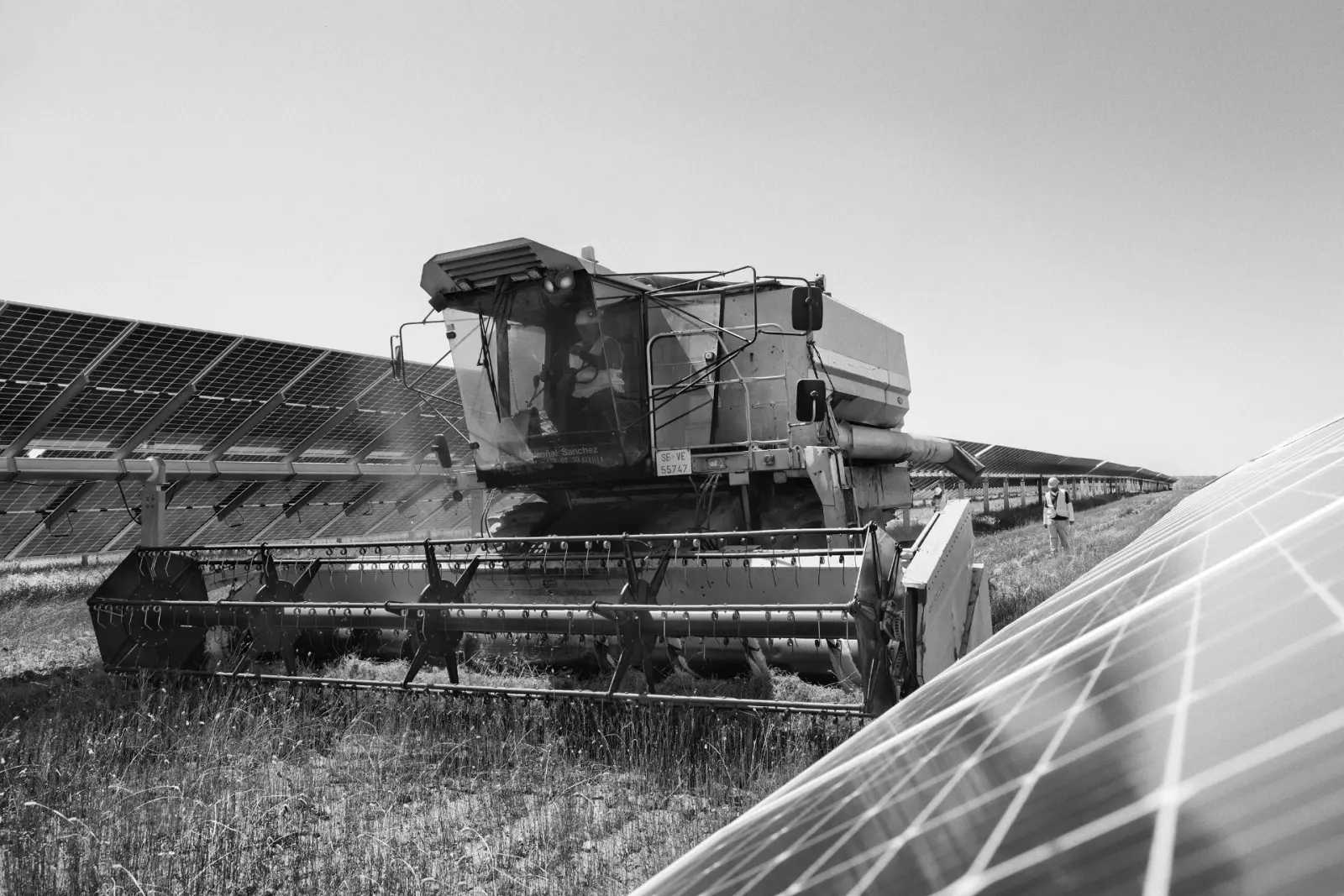
Carmona, Seville (Spain) – 14 June 2023.
Juan Antonio, a farmer and entrepreneur, gathers the first harvest of flax grown between the modules of the Las Corchas solar plant. Energy and agriculture sharing the same hectare.
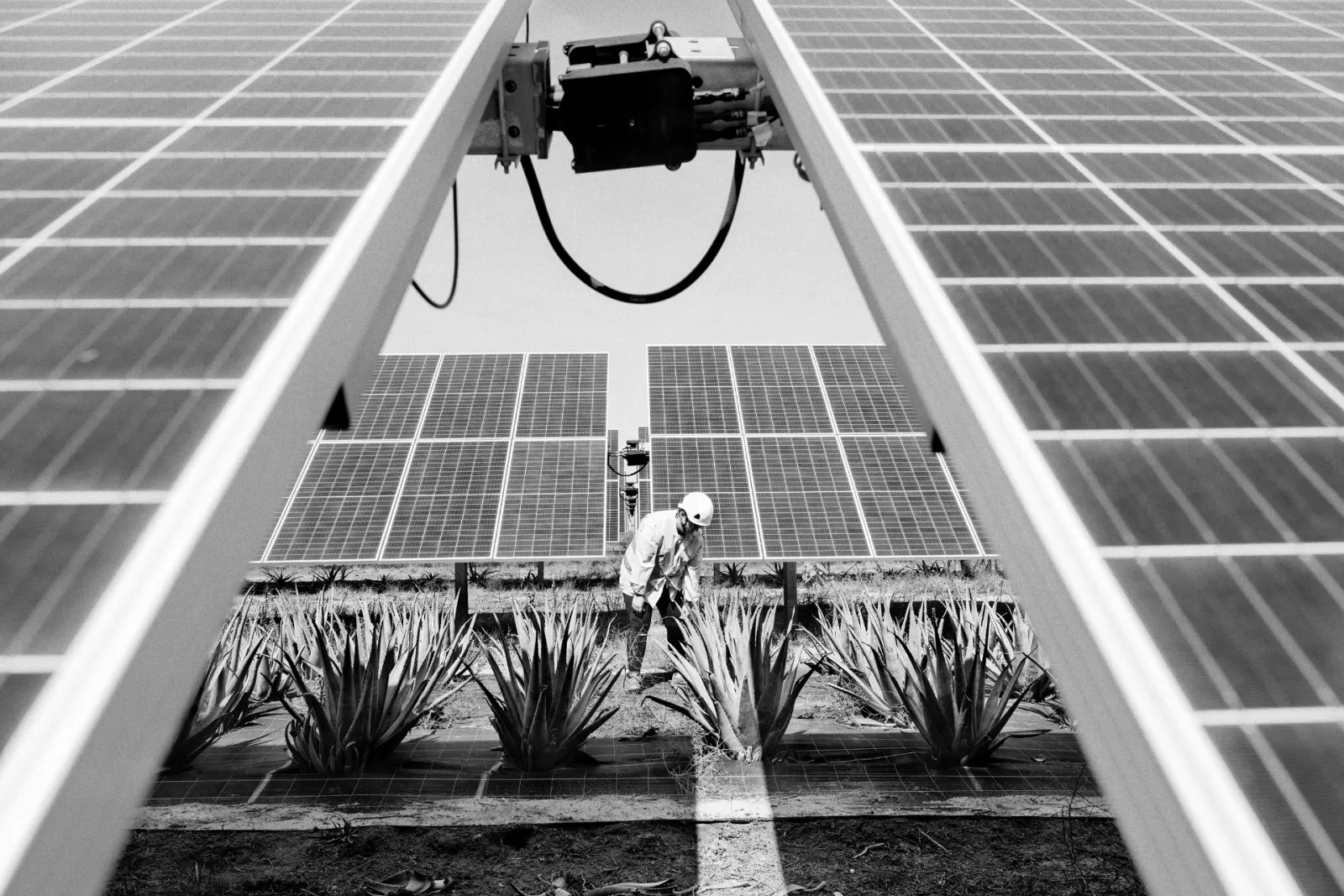
Totana, Murcia (Spain) – 6 June 2023.
A worker checks the growth of crops planted in the free strips of the photovoltaic plant. The shade of the panels reduces evaporation and changes the way irrigation is managed.
Spain finds itself at that point of transformation. Coal belongs to a stage that was essential to its development. Renewable energy opens a new era, marked by diversification, by a different relationship with resources, and by a model more closely aligned with the challenges of the future. Between these two moments lies a period of transition that follows not a logic of rupture, but one of continuity and adaptation.
Because what is taking place is not only the end of an era. It is also the beginning of another.
A stage in which energy ceases to be concentrated and instead expands, in which territories find new ways of taking part in the system, in which innovation and sustainability become pillars of development. A stage that does not erase what came before, but integrates it as part of a broader journey.
And it is in that balance, between memory and transition, that the future is being built.
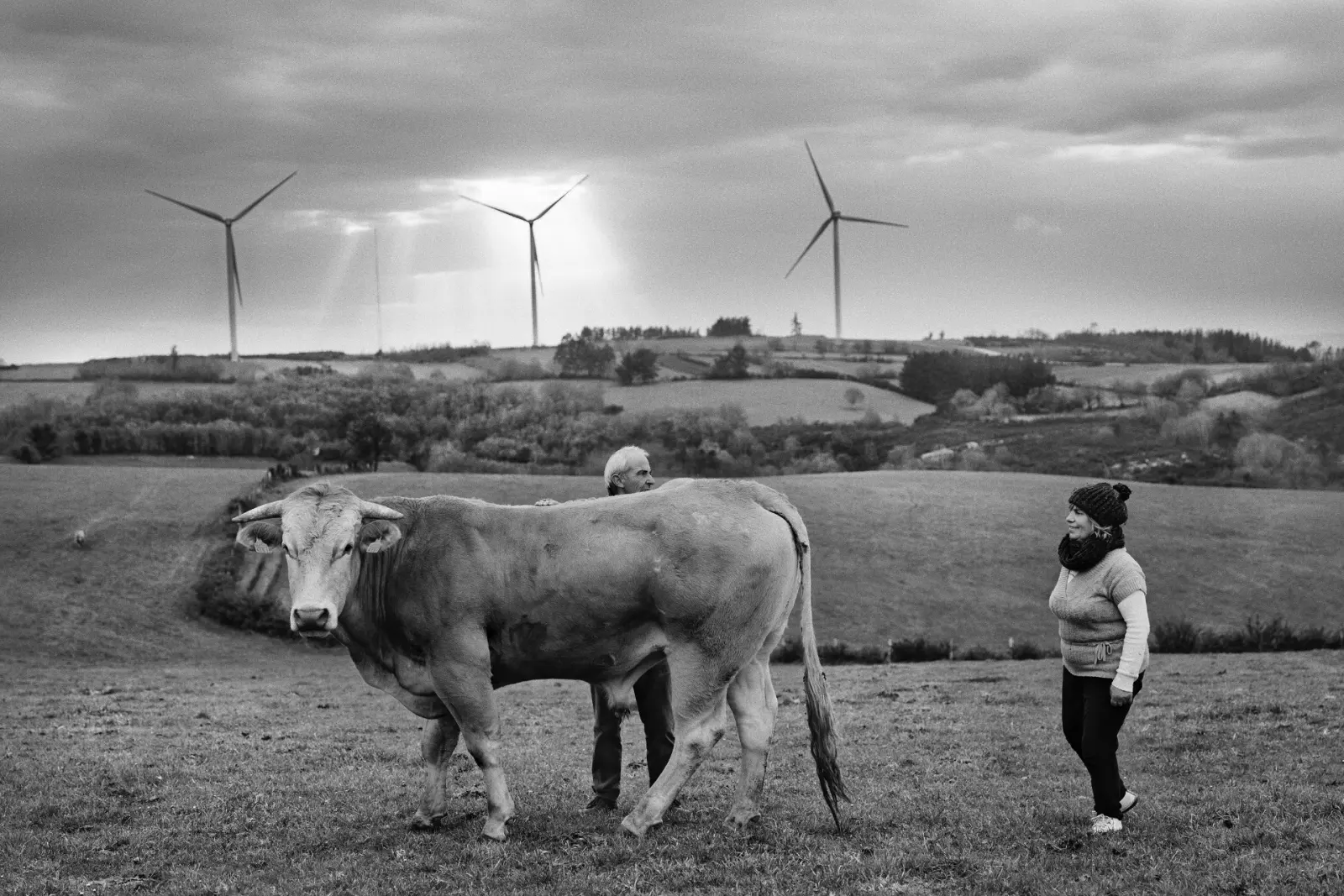
Paradela, Galicia (Spain) – 10 February 2022.
Herders tend their cows beneath the turbines of the Paradela Wind Farm. In Galicia, communal woodland sustains both pasture and towers at once.
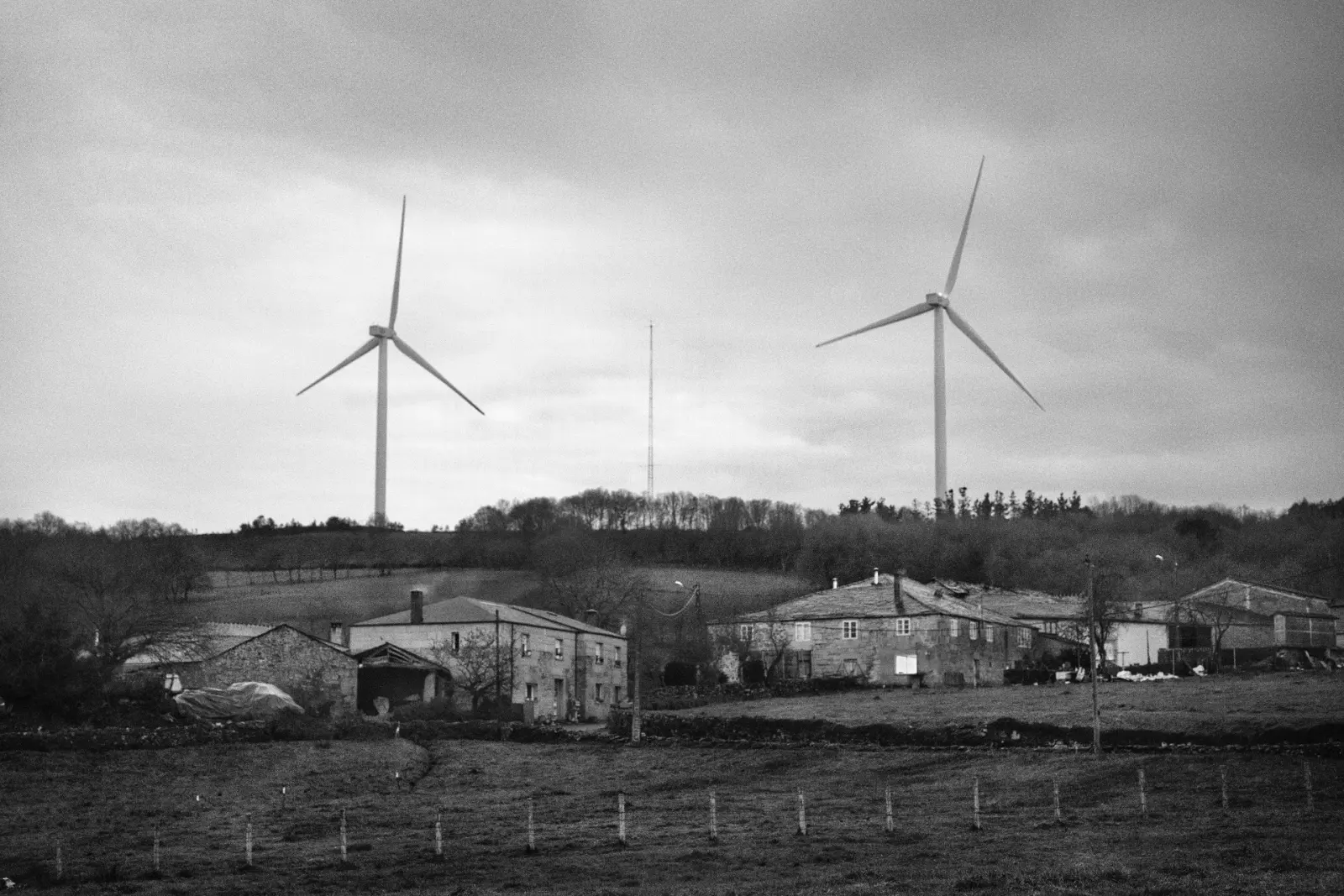
Spain, 2024.
Old and new energy coexisting on the same horizon. The transition does not happen overnight: it layers, stratum upon stratum, onto the landscape we will leave behind.