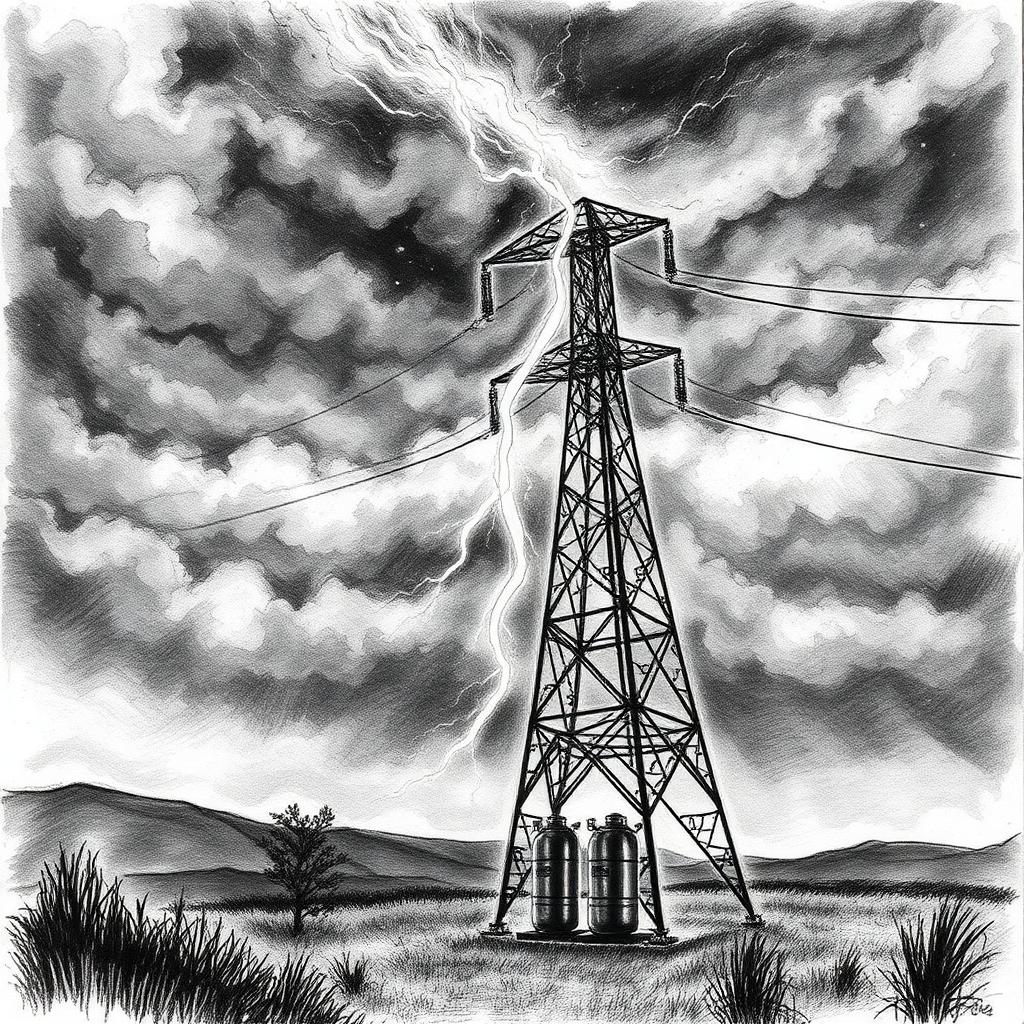
Supercapacitors: a path toward harnessing lightning's energy?
The energy released by a lightning bolt is as fascinating as it is uncontrollable. A single discharge can reach 1 billion joules, enough to keep a television running for nearly ten years. Yet a lightning bolt lasts only microseconds, reaching peaks of up to 200,000 amperes and voltages of millions of volts, exceeding the limits of most materials and electrical devices.
Supercapacitors are devices capable of storing and releasing energy in a very short time, much faster than conventional batteries. However, the difficulty multiplies when accounting for lightning's chaotic behavior: there is no way to predict where a bolt will strike or how many will occur in a given storm.
The history of science is full of attempts to understand lightning. In 1752, Benjamin Franklin demonstrated that it was an electrical discharge. Later, Nikola Tesla dreamed of a world where electricity traveled freely through the air. Laboratory experiments have shown it is possible to store part of the energy from extreme electrical discharges under controlled conditions using banks of supercapacitors.
Futuristic proposals include giant conductive towers connected to supercapacitors, electromagnetic fields to draw lightning toward specific points, and ultra-resistant materials capable of withstanding temperatures above 30,000 degrees Celsius. New-generation supercapacitors, built with nanomaterials such as graphene, offer ultra-fast response times and millions of charge cycles.
Although lightning cannot yet light up our cities, studying it has driven advances in surge-protection systems, atmospheric sensors capable of forecasting storms, and artificial-intelligence models that simulate complex atmospheric phenomena. A single bolt holds enough energy to light a city for seconds — capturing that force remains a near-impossible challenge, for now.
Source: Endesa — La Cara E / Energy Sector