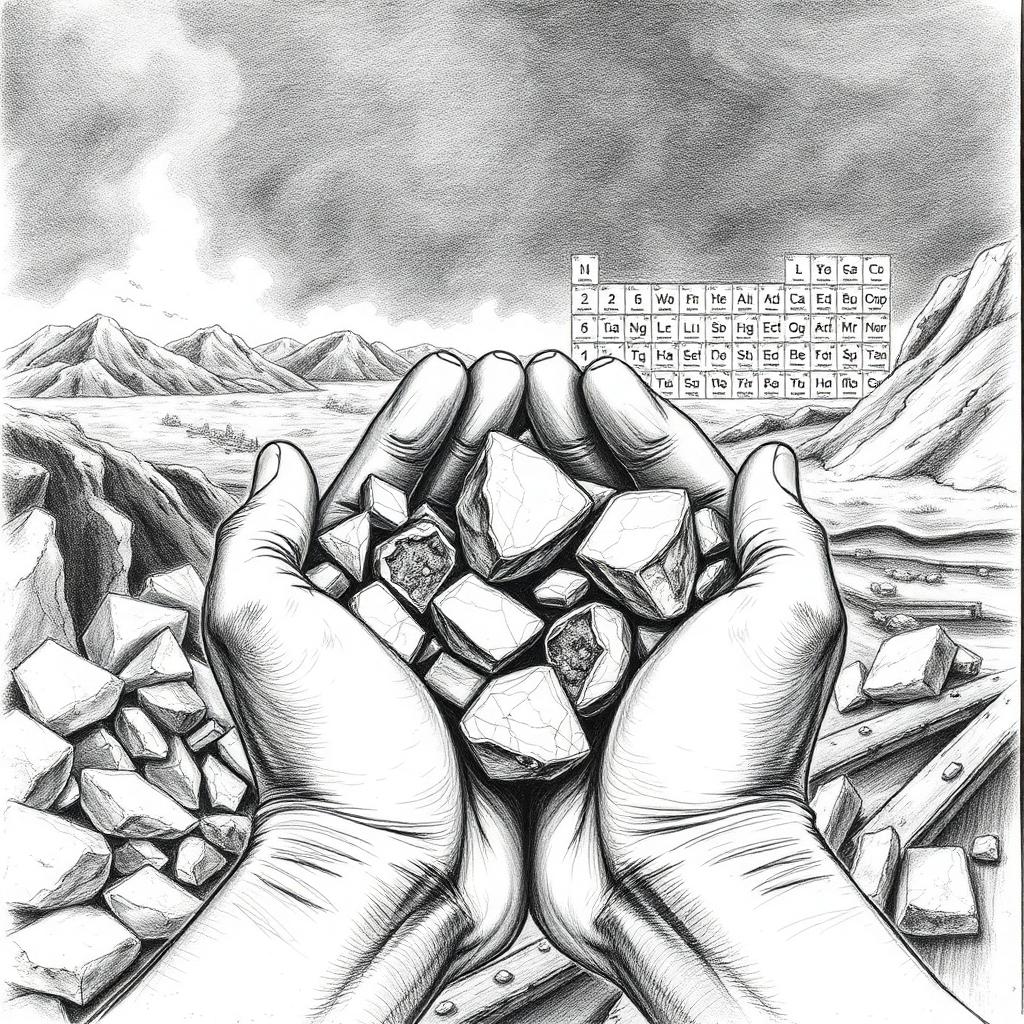
Rare earths: the invisible mineral driving the energy transition
Rare earths are a group of 17 little-known chemical elements found in mobile phones, electric vehicles, high-efficiency wind turbines, telecommunications systems, satellites and industrial applications. Despite their name, they are not actually rare in nature: what makes them special is the difficulty of extracting and separating them, since they are usually mixed with other minerals and require complex, costly processing.
The value of rare earths lies in their atomic structure. Their electron configuration produces powerful magnetic fields, specific optical effects and high electrical conductivity. Permanent magnets made of neodymium and dysprosium turn wind turbine blades; electric motors use neodymium and praseodymium to boost power without adding weight; phone screens owe their colors to terbium, europium and yttrium.
In extraction, China accounts for around 60% of global production, followed by the United States and Australia. But the real bottleneck lies in refining: China controls more than 90% of world capacity. Although other countries extract these minerals, most of the material is sent to China for processing, making rare earths a geostrategic resource comparable to 20th-century oil.
The European Union is pushing initiatives to diversify supply, reopen mines and boost recycling. Spain has launched the first National Mineral Exploration Program since the return of democracy, which will search for minerals across more than 1,000 tailings ponds and former mining areas, with an investment of €400 million to restore soils and improve biodiversity.
According to McKinsey & Company, demand for rare earths will triple before 2035. Recycling will be key: recovering rare earths from old devices, electric vehicles and wind turbines can help create a more sustainable supply and reduce external dependence. The future hinges on technological innovation, geopolitical balance and strategic autonomy.
Source: Endesa — La Cara E / Energy Sector